


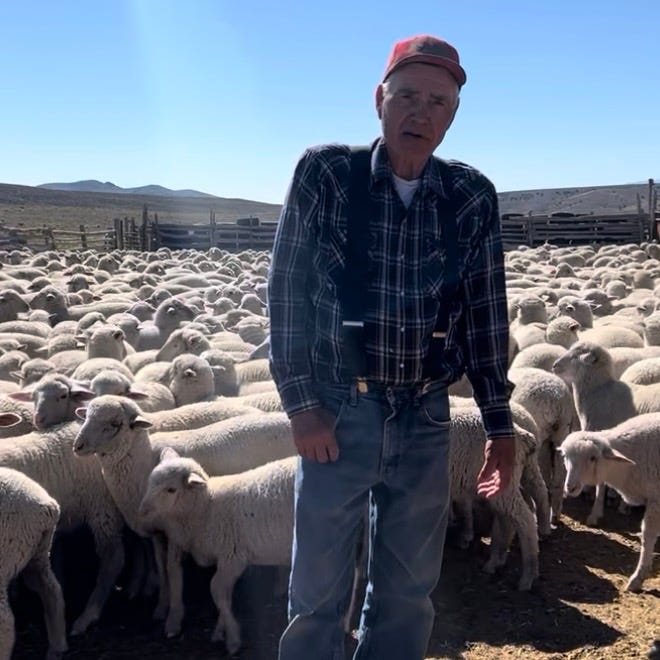
Hank Vogler, a rancher in Spring Valley, Nevada, has been indicted on federal arson charges. The government claims he set two fires on public land in 2022 and 2024. He faces up to five years in prison for each count of “timber set afire”—10 years total.
Vogler is unable to speak about his case on the advice of his attorney.
Vogler appeared before a judge March 19 and entered a plea of not guilty, according to the court docket. He was released on his own recognizance. The trial has been set for May 19.
Last year UNWON reported on Vogler’s issues with the Department of Labor (DOL). Vogler believed he was being targeted by various entities in Nevada because he owns land and water rights in Spring Valley that are wanted by the Southern Nevada Water Authority (SNWA) for a billion-dollar pipeline project that will move water from Spring Valley to Las Vegas.
I’m writing in first person, a break in form for this publication, because I don’t have enough information to provide both sides of the story. I only have my opinion, which is that this indictment should be watched. Vogler is serving as White Pine County Commissioner and running for a second term. His history with the SNWA and government entities including the Bureau of Land Management (BLM) raises questions about these charges. The public should demand full transparency.
I reached out to the U.S. Attorney’s Office, District of Nevada. As of publication I have not received a response. I also contacted the local BLM office, which investigated the case against Vogler. The BLM Public Affairs Director for the Office of Law Enforcement and Security said she is unable to provide further comment or information with judicial proceedings underway, and directed me to the U.S. Attorney’s Office.
Charged with two counts of “timber set afire”
According to his unsealed indictment, Vogler faces two felony counts for setting fires on public land in the Spring Valley area: the Lookout Springs Fire on June 17, 2022 and the North Creek Fire on July 7, 2024.
18 U.S.C. §1855 (“timber set afire”) is a relatively narrow federal statute. While it does not require fatalities or massive acreage, it is typically reserved for willful, unauthorized fire-setting by serial arsonists or those involved in ancillary criminal activity. Vogler, by contrast, is a high-profile public official in the middle of a re-election campaign and a prominent rancher and land advocate.
The North Creek Fire burned approximately 1,100 acres and was contained within about a week. There were no fatalities or structural damage. The BLM initially labeled it human-caused. I could locate no contemporaneous reporting on the Lookout Springs Fire, likely because it failed to meet the threshold for incident coverage. In a state with 504 fires in 2022 and 858 fires in 2024, the Lookout Springs incident appears undocumented until it was leveraged for Vogler’s indictment four years after the fact.
Similar cases further highlight a disparity in federal interest. There is at least one example of another 2024 fire in Nevada started by an illegal burn on BLM land. Johnnie Donald was accused of starting the Raglan Fire, which burned 1,786 acres and threatened homes and infrastructure. Despite the greater impact, Donald was charged only with state-level third-degree arson; he has not been charged federally.
§1855 is often deployed where there is a strong federal interest such as public safety or major resource impact. In Montana, a defendant pled guilty after being linked to more than 40 fires over a period of several years. In California, a professor was charged with igniting fires behind firefighters battling the Dixie Fire. In Washington, federal prosecutors alleged timber poachers sparked a wildfire that burned over 3,000 acres while attempting to steal valuable timber. Most notably, Jonathan Rinderknecht was charged in early 2025 for the Palisades Fire in Los Angeles, which caused 12 deaths, leveled 6,800 structures, and cost an estimated $25 billion in damages.
The allegations against Vogler involve fires that were barely reported, caused no fatalities, and burned zero structures.
While the government can prosecute §1855 in smaller fires, it must typically prove intentional ignition. In a 300-acre fire in the Cleveland National Forest, the defendant was caught at the scene with aerial flares and matches. Vogler, however, is being charged for incidents reaching back years without any public mention of similar evidence.
Court records I reviewed provide limited detail, as information related to the BLM investigation remains sealed. It is unclear what specific evidence prosecutors intend to present. It could be that the government has a strong case, but given the defendant’s profile, the lack of typical “aggravating factors” does make this prosecution appear selective.
History of alleged lawfare against Vogler
The Need More Sheep Company runs 14,000 sheep and 1,000 cattle. Many of Vogler’s hired men are in the U.S. on H-2A visas. In 54 years, Vogler says he has only been able to hire four Americans for these rugged shepherding posts in the mountains of Nevada. At 76 years of age, he works beside his men, as he has for decades.
Vogler claims it was an SNWA employee who reported him for labor issues, setting off the conflict he is currently facing with the DOL. Vogler maintains he follows all labor laws and requirements.
After a 2023 inspection by the DOL, his employment program has been put in jeopardy. According to Vogler and individuals familiar with his operation, the alleged violations appeared pedantic: a bag of rice left open in a remote mountain sheep camp was cited as a violation of food safety laws; a bucket of water left out for horses was declared “stagnant” and therefore dangerous; in the bunkhouse, the beds were five inches too close to the floor (Vogler says his men removed the pegs so they could take their boots off while sitting on their beds). The DOL also claimed one worker’s tenure was not properly documented; Vogler says officials confused this man with his father, both of whom worked on the ranch and have the same name. I spoke with another worker on the ranch named Luis Rivas Reyes who confirmed this account.
The DOL did not return my request for comment. An SNWA spokesman denied any involvement in Vogler’s issues with the DOL.
“While we have had disagreements with Mr. Vogler in the past, we are not aware of any labor disputes or challenges that he’s having with staffing,” said Bronson Mac, a spokesman for SNWA.
Reyes and others with knowledge told me Vogler is a good and fair employer. One rancher said Vogler is a lightning rod who is not afraid to fight for fair treatment, and this has put a bullseye on him. This individual spoke on condition of anonymity, afraid of reprisal from the government.
Vogler said he had been threatened with over $42,000 in fines and a potential three-year suspension of his H-2A program, which he said would be a death blow for his operation. He argued that federal enforcement actions were disproportionate. At a time when the Trump Administration was deporting thousands of illegal farmworkers, Vogler, who has hired foreign workers the right way since 1977, felt he was being targeted unfairly. He connected his issues with SNWA’s desire for his land and water.
This is an abbreviation from my original report; I’ve removed the paywall and linked it below. Please read, share, and help keep officials involved in this case accountable. Vogler’s history suggests there could be more to the story. I will continue to track this case and report on its progression.
Read the original report:
For 50 years, this rancher followed labor law. As big ag lobbies for amnesty, he is about to lose his legal crew.

Hank Vogler has spent much of his 76 years in sheep camp. He built his livestock empire over decades of hot days in the Nevada sun and cold nights under a high desert moon. The Need More Sheep Company runs 14,000 sheep and 1,000 cattle in Spring Valley north of Las Vegas. That could all…
Las Vegas doesn’t need anymore water. It’s already a boring, ostentatiously wasteful eyesore that serves only to deplete savings from hardworking people and retirees. The idea that they would steal water from a rancher to enable even more of the same nonsense is awful, but that they could succeed is even worse. I would love to see a law protecting water rights for local residents and agriculture over industrial and commercial usage. Drinking water is too often treated as a hard commodity, like oil, instead of as a resource essential for life.
I remember your original report on this situation. Thank you for bringing government over reach to light again and again.. it’s upsetting and frustrating when I read the stories about government and large corporations, working hand-in-hand to take natural resources from individuals. They have unlimited money and therefore unlimited lawyers and can just wear you down. Very sad.