


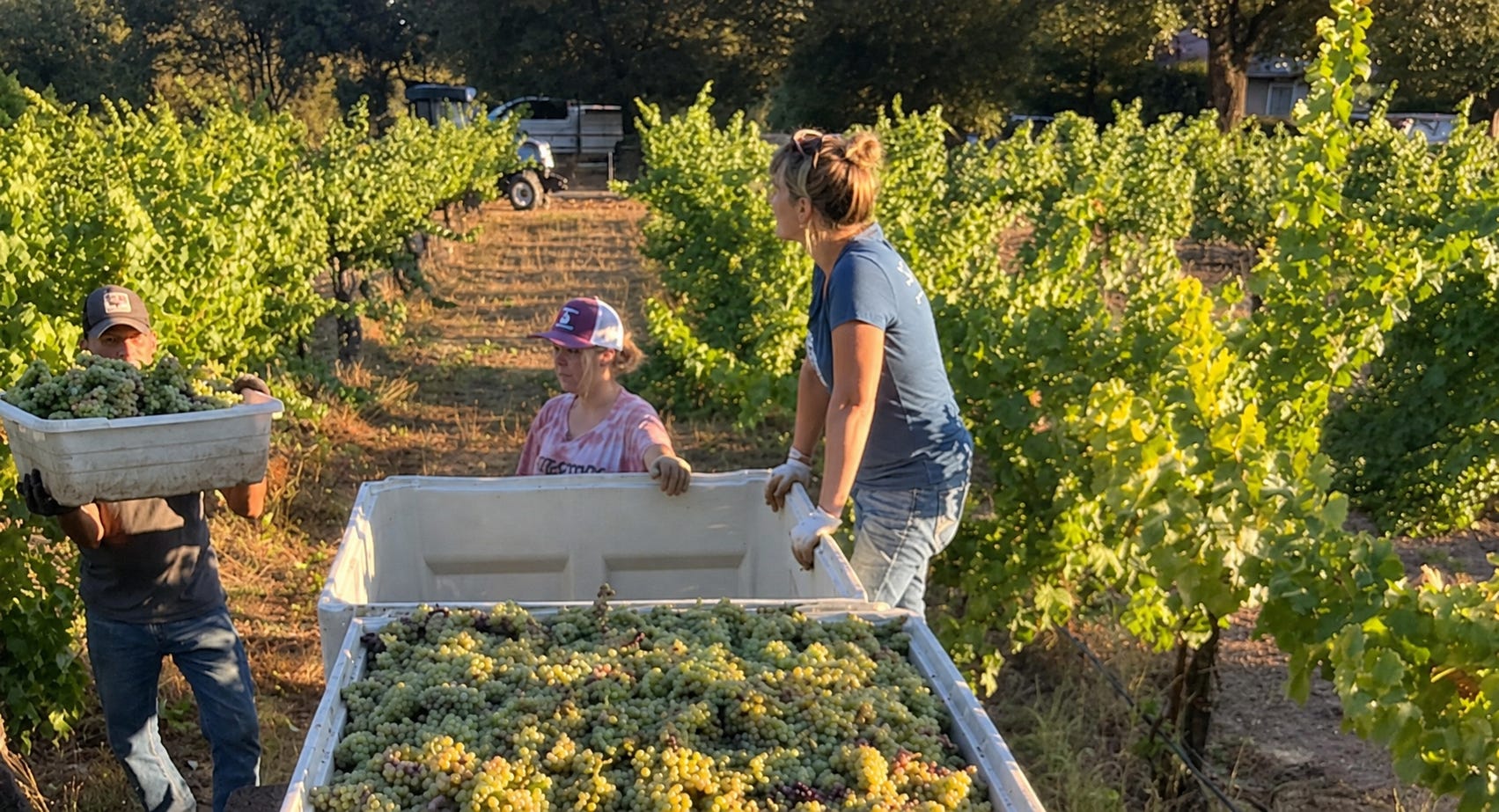
When you buy a bottle of wine labeled “American,” it could contain foreign fruit—as much as a quarter of its contents grown overseas.
“25% can be grown anywhere in the world and they can still put the American name on it,” says Natalie Collins, president of the California Association of Winegrape Growers (CAWG).
The rule allows large wineries to blend cheaper foreign wine into products marketed as American, even as American growers struggle to find buyers for their grapes.
This year, CAWG co-sponsored Assembly Bill 1585 in California. It would have required any wine processed or sold in California and carrying the American label to contain 100% American-grown fruit. A similar law is already in place for California: The California label is limited to wine made from California grapes.
Supporters sent more than 10,000 letters backing AB 1585. The bill passed the Assembly unanimously, 67-0, only to stall in the Senate. It never received a hearing. Collins says opposition from big beverage companies helped kill it.
“I think at this point we really saw the power of these large multinational companies and the trade organization that represents them,” she says.
The European Union prohibits blending outside wine into wine carrying an EU label. Australia requires wines blended from multiple countries to disclose each country of origin on the label.
The United States is the one exception.
Bulk foreign wine imports undercut homegrown grapes
Bulk wine is finished wine shipped in large tanks and blended after it arrives. Chile is the largest source of imported bulk wine, followed by Australia.
Last year, nearly 40,000 acres of California vineyards were torn out. The state is on track to lose another 47,000 acres by the end of 2026.
“We had a very challenging year where growers left over 600,000 tons of fruit on the vine, just rotted. Farmed an entire season, all input costs, and essentially never got a paycheck,” Collins says.
Bulk wine imports rose 24% in 2025 over the previous year—a total of more than 37 million gallons.
Opponents of AB 1585 say they need flexibility to blend imported wine in down years, when drought or wildfire cuts a crop short. Collins says there has not been a shortage in the last five years “in the slightest,” but more importantly, nothing in the bill would stop winemakers from blending.
“A winemaker could still blend in foreign fruit with American wine,” she says. “It just simply couldn’t be labeled ‘American.’”
California vineyards disappear as growers lose buyers
This year, about half of California’s wine grape crop entered the harvest season without contracts, compared with about 20 to 30% in a normal year, the Associated Press reported.
Natasha Ricetti grows grapes in Talmage and Redwood Valley. This should have been her grandmother’s 50th harvest. Instead, her family is facing its third year in a row without a harvest.
“At some point, you start to wonder how long we can keep going. Do we look for other crops to grow? Can we hold out long enough for the market to recover? Do we take on outside jobs just to keep the farm running? There are so many heavy questions hanging over you, and while you try to figure out the answers, the vines still must be farmed.”
In 2023, the volume of foreign bulk wine imported into the U.S. was roughly equivalent to the amount of domestic grapes left unharvested on the vine, Ricetti says. Worse, the U.S. government incentivizes imports through a program called duty drawback.
“Large wineries can import this bulk wine cheaply not only because foreign farming costs are lower, but also because of the duty drawback loophole. As long as a company exports a similar product within five years, they get 99% of their import taxes and tariffs refunded. That policy actively incentivizes foreign imports while leaving American growers with unsold fruit.”
A 2018 review by U.S. Customs and Border Protection found that bulk wine imports increased 875% between 2004 and 2016, while exports grew by less than 6%. As a result, CBP moved to end the duty drawback program. Then, beverage industry groups sued, and a court ruled CBP couldn’t end the practice without Congress.
Growers say it was also Big Beverage that killed AB 1585.


How AB 1585 was stopped before its Senate hearing
After passing the Assembly unanimously, AB 1585 went to the Senate Governmental Organization Committee. Four days before its scheduled hearing, Senator Susan Rubio, chair of the committee, released a 14-page analysis warning that the bill could “displace workers, hurt bottling operations and expose the state to significant constitutional risk.”
The bill’s authors, Assemblymembers Rhodesia Ransom and Damon Connolly, subsequently pulled it, saying they no longer had the votes.
Ransom told the San Francisco Chronicle that support looked solid until days before the hearing, when senators began changing their minds.
Opposition included some of the country’s largest wine and beverage companies. The Wine Group and Treasury Wine Estates testified against AB 1585 in the Assembly and were listed as formal opponents, along with the Wine Institute and Wine & Spirits Wholesalers of California. State lobbying records show Gallo, Delicato, and Constellation also hired lobbyists on the bill.
Three days after AB 1585 passed the Assembly, campaign finance records show that Gallo contributed $5,900 to Senator Rubio—the largest contribution permitted for an individual election, according to reporting by the Chronicle.
Rubio did not respond to a request for comment.
Crisis for the American wine industry
Foreign imports aren’t the only problem. A trade war with Canada, wildfires and overregulation in California, economic turmoil, and a shrinking market for alcohol have all contributed to wine’s decline.
“No one wants to be the generation that closes the doors on an operation,” Collins says. “And sadly, right now, many California wine grape growing families are having to make those choices.”
AB 1585 was an effort at truth in labeling for consumers, and a fair playing field for growers.
In 2022, bulk wine from Chile and Australia was half the cost of California wine. Collins says California growers carry costs and meet standards foreign competitors don’t, from wages and labor rules to water quality, worker safety, and sustainability programs.
“When you cannot meet a standard, you don’t get to benefit from the name,” Collins says.
Growers say large beverage companies are benefiting from the reputation and marketing power of the American wine labelƒ without supporting American producers.
“When I explain this to consumers, almost none of them realize that a bottle labeled ‘American’ can legally contain up to 25% foreign fruit from countries like Chile or Australia,” Ricetti says. “How are those crops grown? What kind of pesticides are being used, and how are their workers treated? We simply don't know how they are regulated. When you hear that a bottle of wine is ‘organic enough,’ what does that even mean?”
When vineyards disappear, the losses go beyond growers and farmworkers. Communities across rural California rely on wine tourism. The loss also hurts small towns and their restaurants, shops, hotels, and tasting rooms.
“When the grapes go unharvested, farm workers lose hours or face layoffs,” Ricetti says. “That strain carries directly into our local economy, affecting everyone our agricultural community supports.”
What’s next for truth in wine labeling efforts?
Collins says they’ll likely push the bill to protect the American label again next year, and plan to file a federal petition to change the rule.
Wine labeling is regulated by the Alcohol and Tobacco Tax and Trade Bureau (TTB), part of the Treasury Department. Collins says several other states plan to co-file the petition. She also hopes to get the U.S. Department of Agriculture on board.
The last time CAWG filed a petition was around 2009. It took more than five years to reach rulemaking. For growers already on the brink, that timeline could be too long.
“Once those vineyards are gone, what goes in behind them?” says Ricetti. “I’m not sure what is more concerning: the possibility that this market might not recover, or what might replace these vineyards once they are gone.”

Thanks. I’ve downloaded a list of wines sold by Gallo, Delicato and Constellation. I’ll make the effort not buy any of these.
It’s pretty vile.