


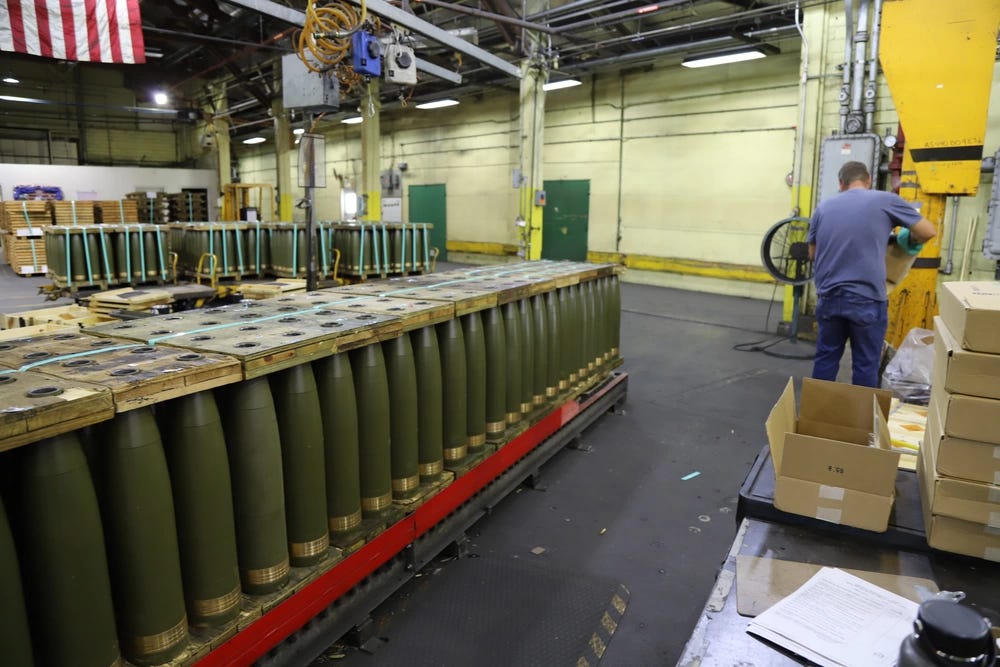
The Army is set to blow up nearly five tons of deteriorating explosives at the Iowa Army Ammunition Plant tomorrow at 9 a.m. Farmers, ranchers, and rural residents want to know how much lead could contaminate their land.
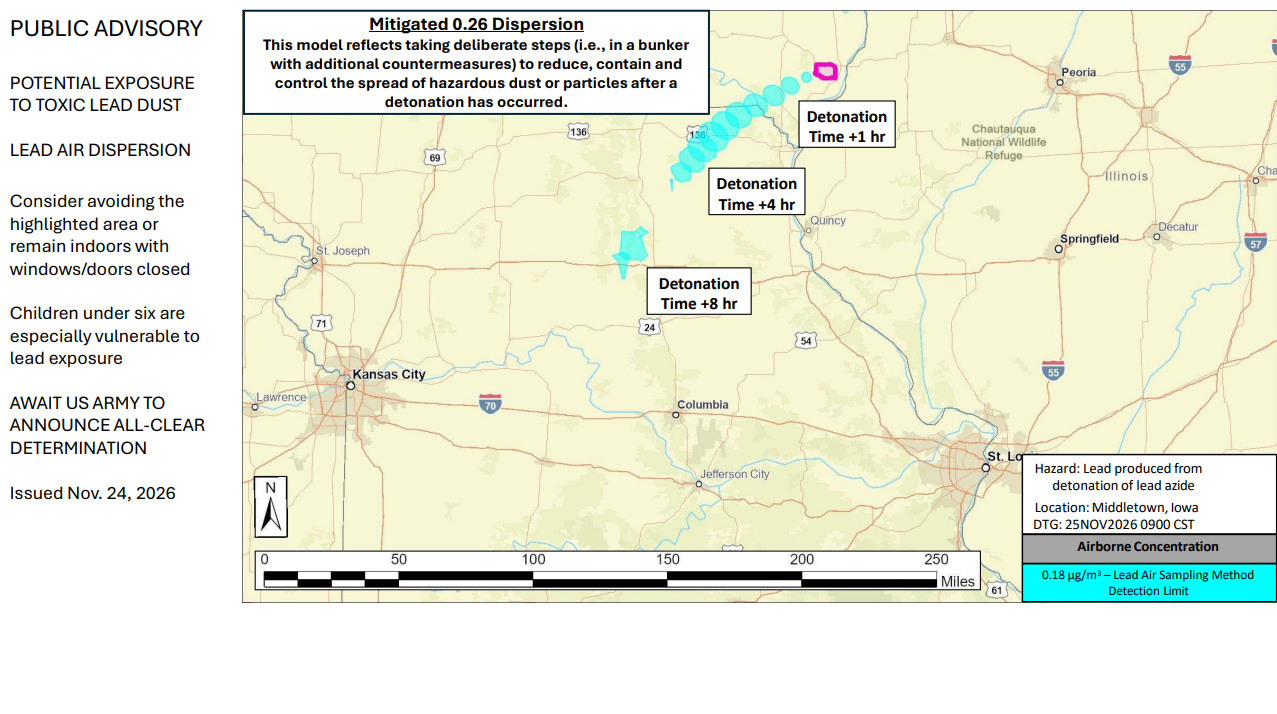
Two controlled detonations of the unstable bomb-making material will take place at the Middletown plant in Des Moines County, in southeastern Iowa, and could impact nearly 150 square miles according to recent modeling.
“There are approximately 350 farms that could be impacted based on the anticipated direction of the plume,” said Richard Fordyce, USDA Under Secretary for Farm Production and Conservation.
Officials say they learned about the degrading lead azide in March. After decades in storage, the material has become highly sensitive to shock, friction, heat, and static electricity. The Army says the choice is between a spontaneous explosion and a controlled detonation timed for optimal weather and wind, with mitigation in place.
“It’s down to the least bad choice that we have in this situation,” says an Army veteran, former government scientist, and PhD chemist who asked to remain anonymous. “It’s better to do it when you can control it rather than have an uncontrolled detonation. If they leave it there, it could go any time.”
“Lead is bad, azide is bad, and together they make a primary explosive,” he adds. “That’s what lead azide is for: to make a secondary explosive blow up.”
The risk of an explosion increases as temperatures drop. Acting Secretary of the Army Adam Telle said temperatures will soon drop below freezing, risking “further destabilization.”
While a controlled detonation may be the Army’s best option now, 9,500 pounds of aging explosives sat in bunkers for years, improperly stored. Rural communities in Iowa and Missouri will pay the price.
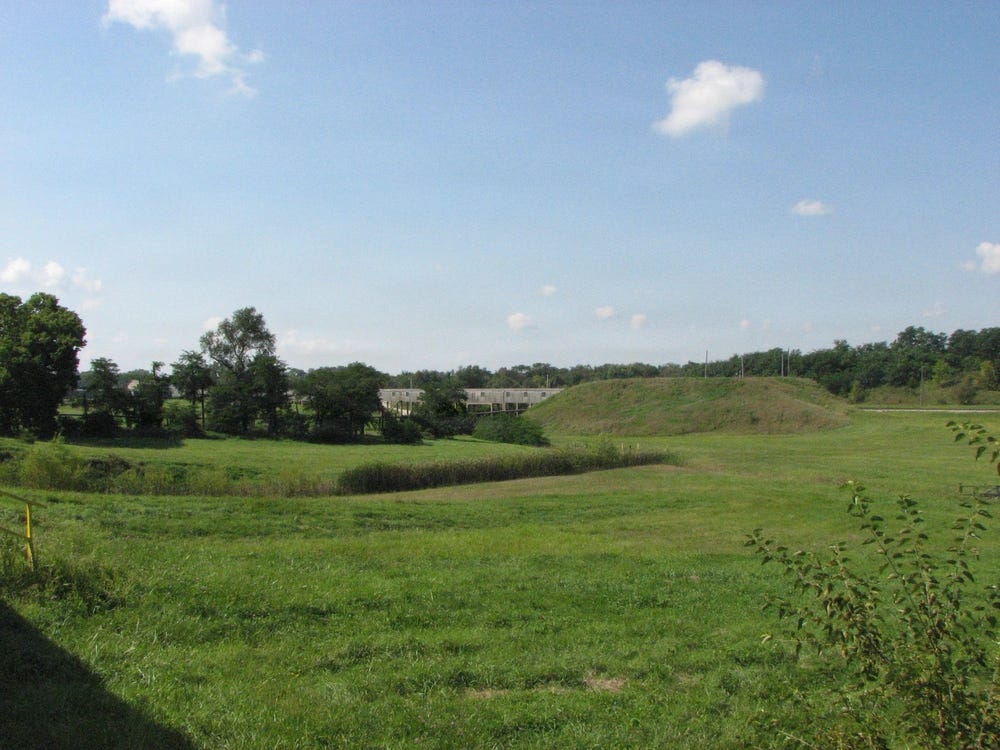
Trump seeks consensus
Last Thursday, the Eighth Circuit Court of Appeals ordered a stay to the planned detonations after a last-minute lawsuit. Citing emergency powers, the Army said on Sunday it would move forward anyway.
President Trump asked the Army to wait for a final decision from the court, as well as approval from Governor-elect Rob Sand, a Democrat. He appeared to want bipartisan buy-in. In a lengthy post to Truth Social, Trump said the problem was inherited.
“In 2009, the Obama Administration improperly stored a vast number of explosives,” he wrote, adding that experts “feel there is a substantial chance that this material will explode of its own volition.”
The president also warned that if Sand or the courts did not agree, the Army would not proceed, and he would “hold the incoming Governor responsible for any and all death or destruction.”
The court lifted the stay, declaring the risk is “between a controlled detonation and an unplanned explosion, not between the risk of a controlled detonation and no explosion at all.”
Acting Army Secretary announces detonation date
After Iowa Governor Kim Reynolds signaled cooperation with federal agencies, and Governor-elect Sand deferred to experts, Army Secretary Telle announced detonations were back on for Wednesday, pending wind reports.
“Every expert agency agrees, and both Iowa’s current and incoming Governors say the call belongs to the experts,” he said, naming the Army, Navy, Environmental Protection Agency (EPA), Bureau of Alcohol, Tobacco, Firearms and Explosives (ATF), Federal Bureau of Investigation (FBI), Defense Advanced Research Projects Agency (DARPA), Department of Energy (DOE), Centers for Disease Control and Prevention (CDC), Department of Health and Human Services (HHS), and Federal Emergency Management Agency (FEMA).
Possible alternatives explored
“When I first saw they were going to explode it, I thought they could chemically treat it,” says the former government scientist who asked for anonymity. “But when it’s so degraded, it gets to the point where even being in the room is a hazard. They left it so long it’s not safe to move. In these cases, they do a formal risk assessment to find what allows them to neutralize it while minimizing hazards to personnel and the environment.”
“There are chemical means to neutralize lead azide, basically pouring other chemicals onto it,” he says, “but even those are hazardous just by the nature of the material.”
In March, when the Army first found the 68 drums of degrading explosives, it planned to dissolve the lead azide with chemicals, and hired MuniRem Environmental, a Georgia-based firm.
Two months later, the Army canceled its contract with MuniRem. Agency officials say the lead azide had recrystallized into a form too shock-sensitive to handle without risk of accidental explosion. Moving the drums or even opening the lids to drop in chemical agents could set it off.
The court said the Army had considered alternatives, including “on-site chemical treatment, closed chamber thermal treatment, relocation of the individual drums of lead azide, and intentional detonation inside earth-covered magazines.” It found petitioners were unlikely to succeed in challenging the EPA’s findings.
While the Army has explained why it believes detonation is now necessary, it has not yet answered the broader question of how the stockpile reached this point.
“Multiple people had to be criminally negligent in order for this to happen,” said Daniel Hummer, associate professor of geology at Southern Illinois University. “If I had a tiny fraction of the lead azide in my lab that they have in those barrels, and I were as negligent as the Army had been, I would definitely be criminally charged.”
Mitigation efforts and projected impact
The Army has added additional protective measures since postponing the detonations. Telle described a dam installed Monday night to flood the area around the munitions with a liquid foam designed to absorb lead.
“Our goal is to keep as much of it as we can here on our Iowa Army Ammunition Plant to prevent it from traveling outside,” Telle said at a Tuesday press conference.
The Army, EPA, and University of Iowa are deploying soil and air monitors throughout the area. NASA research aircraft with space-based observation facilities will track the plume.
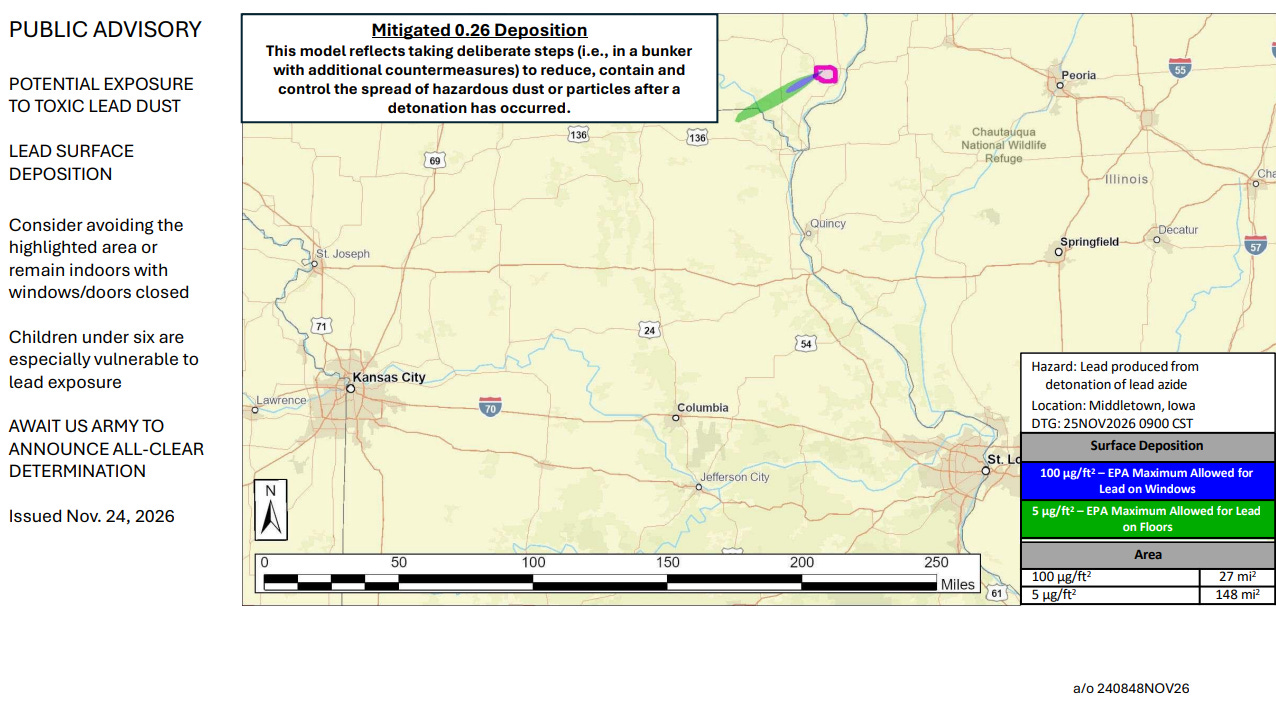
The Army’s latest projections show lead deposits of at least 5 micrograms per square foot across roughly 148 square miles southwest of the plant. In a smaller area of about 27 square miles, deposition could reach at least 100 micrograms per square foot.
The EPA sets post-renovation lead levels at 5 micrograms per square foot on floors, 40 micrograms per square foot on interior window sills, and 100 micrograms per square foot in window troughs. These apply to indoor surfaces, not outdoor areas or agricultural land.
Crews have built blast barriers around the two storage bunkers. According to the Army’s environmental review, the earthworks include about 19,000 cubic yards of lime-fill foundation and 300 sand-filled barriers, with a 28-foot opening that vents the blast to the south and southwest, away from populated areas. Crews will soak the area with water and use misting to suppress toxic dust.
Writing for Science magazine, Derek Lowe says Iowa soil has a mean lead concentration of 20 mg per kilogram, meaning there’s “already more naturally-occurring lead in the soil than what the Army is adding to it.”
“This lead plume, while highly undesirable, is still not going to turn a swath of Southeast Iowa into some kind of toxic wasteland,” Lowe writes.
Jeffrey Catalano, a professor of earth, environmental and planetary sciences at Washington University in St. Louis, told Iowa Public Radio the risk to agriculture is likely low.
“Given how dispersed it will be, the amount of new lead coming in per unit area of agricultural land, and the fact that once it’s sat in soil for a little bit, it’s pretty unreactive, and plants won’t take it up, I think the long-term risk to agriculture in the region is very low,” Catalano said. “I don’t think you would find a measurable increase in lead in next year’s corn crop versus this year.”
He recommended keeping livestock indoors and on feed Wednesday and a few days following.
Divided public reaction to the detonations
Retired Army Special Forces soldier and podcast host Matt Tardio says the “sad truth” is that the planned detonations are the best available option.
“Unless this is detonated in a controlled manner using the proper amount of explosives, it could detonate by itself, caused by the pressure of its own weight, and that would be bad,” Tardio says. “It’s probable that it would cause a low order detonation and not be completely destroyed. That would fling an unknown amount of lead azide into the environment. The military is attempting to prevent this.”
Tardio also defended the military personnel handling Wednesday’s operations.
“The men and women of the military are risking their lives to ensure it does not contaminate unnecessarily. Now, the media is fear mongering and making those same men and women out to be monsters. Let them do their job.”
Not everyone shared Tardio’s assessment.
“Of all the things that have happened in my lifetime I am not exaggerating when I say this is one of the worst,” said Meghan McCain in an X post.
Zach Lahn, the Republican candidate in the recent Iowa governor’s race, called the situation a “decades-long failure across administrations.” He built an interactive map where residents could enter their addresses and receive official guidelines for their location.
Residents brace for Wednesday
Based on the Army’s latest modeling, lead-containing particles are expected to drift southwest through part of southeastern Iowa and into northern Missouri. Earlier models showed the plume could travel up to 100 miles from the detonation site, depending on wind. Illinois is outside the current predicted impact zone.
“Both USDA and FDA have proper protocols in place to ensure there are no heavy metals, including lead, in the food that enters the supply chain,” Fordyce said.
Even small amounts of lead exposure are a concern, particularly for children and pregnant women, because lead is a neurotoxin.
Officials are asking some Middletown residents to leave during the blasts. Anyone who stays should keep windows and doors closed. A shelter has been set up at 17879 Highway 79.
Schools in Mediapolis, Columbus, Danville, and Winfield Mt. Union will be closed.
Timeline of the Iowa lead azide crisis
2009: The nation's stockpile of lead azide, nearly 10,000 pounds and some of it more than 60 years old, is moved to the Iowa plant, according to federal officials.
March 2026: During a safety review, the Army Joint Munitions Command finds that 68 drums of lead azide have degraded.
Mid-October 2026: The Army holds an open house in Middletown to discuss controlled detonation.
November 13: The EPA approved an emergency permit for the detonations under federal hazardous waste law.
November 15: The Army announces a detonation date—Friday, Nov 20—and releases air dispersion models.
November 19: Acting Army Secretary Adam Telle postponed the detonation to Monday, Nov 23, saying “public safety is the Army's top priority.” Later that day, the Iowa Environmental Council and the Sierra Club Iowa Chapter, represented by Earthjustice, challenged the EPA’s emergency permit. They claimed the permit failed to entertain less dangerous options. The Eighth Circuit Court of Appeals issued a pause to the scheduled detonations pending a final ruling.
November 22: The Army moved the detonation date to Wednesday, Nov 25, but said it intended to move forward in spite of the court’s order on an emergency basis. The DOJ simultaneously asked the Court to lift the pause.
November 23: Seeking bipartisan agreement, Trump ordered a halt to the detonations until a federal court and Iowa’s incoming Democrat governor agreed to the plan. Later in the day, the court lifted its stay, finding that the permit’s safeguards—including barriers, weather restrictions, public notification, lead sampling, and cleanup—were adequate. Because both sides agree the detonation will cause some public harm, the court ruled the only real choice was between a controlled detonation with mitigation measures in place, and an uncontrolled explosion without mitigation measures. Current Iowa Governor Kim Reynolds voiced cooperation, and Governor-elect Sand declined to approve or reject it. That evening, the Army confirmed the detonation for Wednesday morning, Nov. 25, calling it a “consensus decision.”
Resources for locals
U.S. Army detonation maps, advisories and FAQ - The Army will post updated maps six hours before detonation and every hour until it happens.
FEMA hotline: 1-800-621-3362 (FEMA is helping residents who choose to leave and has sent emergency alerts to area phone numbers)
Gov. Reynolds issued a disaster proclamation on Tuesday for Des Moines, Lee, and Van Buren counties, which activates county and state response plans
USDA Resources for Farmers and Ranchers in Iowa
Iowa HHS guidance for schools and child care facilities
Iowa Department of Health and Human Services (HHS): Lead Exposure and Blood Lead Testing FAQ
Des Moines County Public Health (also serves Van Buren County): 319-753-8290
Iowa HHS Childhood Lead Poisoning Prevention Program: 800-972-2026. If you can’t pay for a test, contact your local health department or Iowa HHS.