

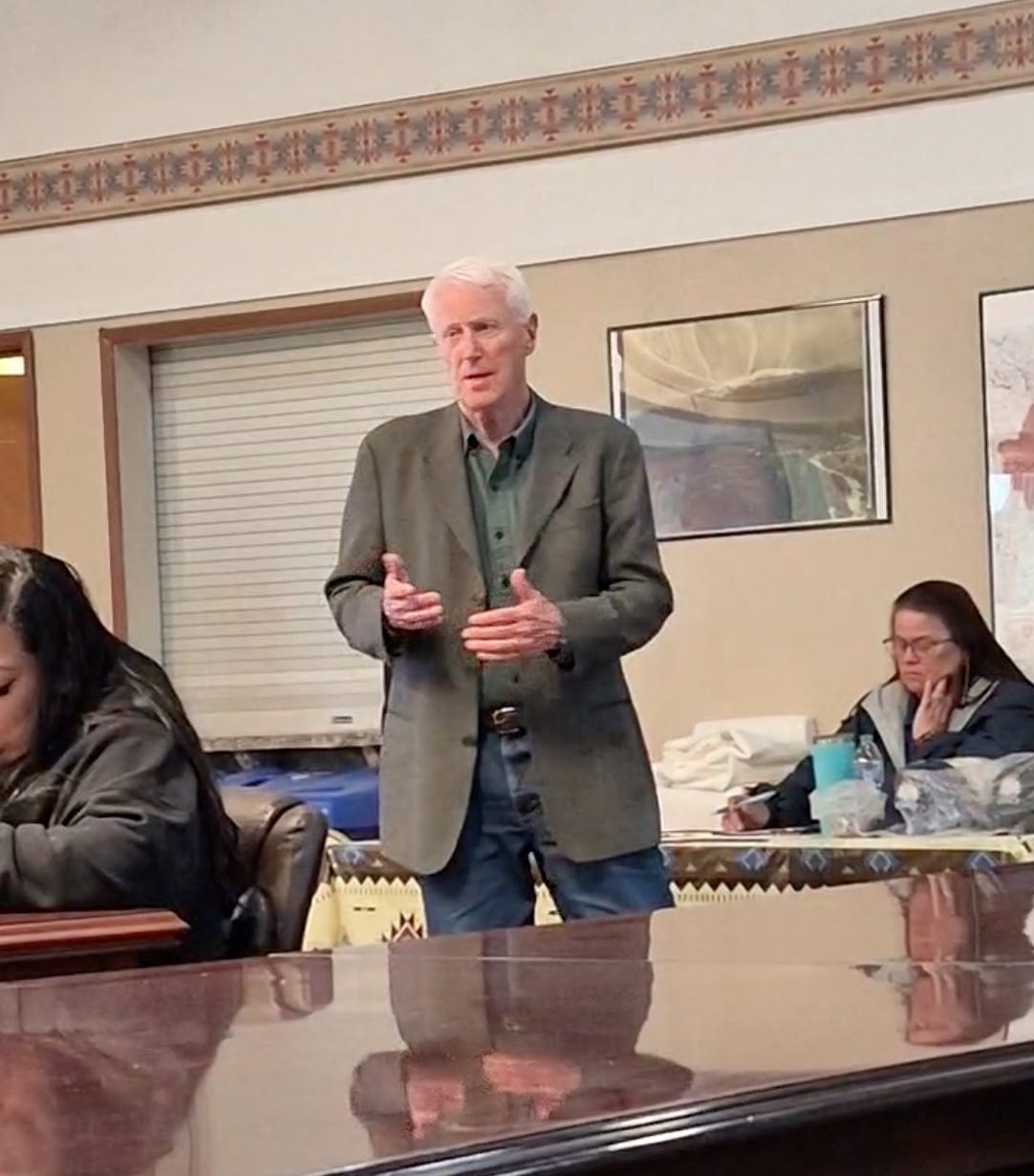
A recent Round Valley Indian Tribes (RVIT) meeting adds sobering details to a water diversion plan being touted as a replacement for the Potter Valley Project.
RVIT is set to assume all water rights once dams are torn out. Impacted communities in Mendocino and Sonoma counties have been assured they will continue to receive Eel River water diversions.
This meeting suggests otherwise.
“There will come a time when, no matter what happens, the diversions will stop,” said Curtis Berkey, water attorney for RVIT, in the November 22 meeting. “That will happen for sure.”
“The Two-Basin Solution is checkmate. The end of Potter Valley…”
The Potter Valley Project was built over a century ago to generate hydropower and store surplus winter rainwater for the region’s dry summers. The dams in the project divert less than 2% of the flow of the Eel River. This water, which is stored in Lake Pillsbury, would otherwise be lost in the Pacific Ocean. Lake Pillsbury water is released during dry months to Russian River communities as well as back into the Eel River, which also sees low levels during the summer.
Pacific Gas & Electric (PG&E) has asked the federal government for permission to demolish the dams after years of environmental lawsuits from groups like California Trout (CalTrout) and Trout Unlimited. If Potter Valley dams are removed, over 600,000 people in an agricultural and fire-prone region will lose water.
These communities are being told the so-called Two Basin Solution will ensure a continued water supply. They will be interested to hear that, based on conditions described in the RVIT meeting, groups set to control this water after dam removal appear likely to not only supply no summer water at all, but guarantee the end of all diversions.
“This is what we’re locking ourselves into with this agreement,” says a Potter Valley rancher who asked to remain anonymous. “Why would the feds or anyone else give hundreds of millions of dollars to develop future water storage—raise dams, put in reservoirs—under this agreement? This Two-Basin Solution is checkmate. The end of Potter Valley and beyond.”
RVIT water attorney: “Diversions will stop”
About 450 of RVIT’s 5,000 members live on the Round Valley reservation, which sits on the Middle Fork of the Eel River. The tribe claims their water has been stolen by the Potter Valley Project for over 100 years, harming their fisheries.
Berkey said the tribe has had three goals: to turn the Eel River into a “free flowing” river, restore fish populations, and stop water diversions.
“I’m happy to say that we are on the road to achieving those goals,” he told tribal members.
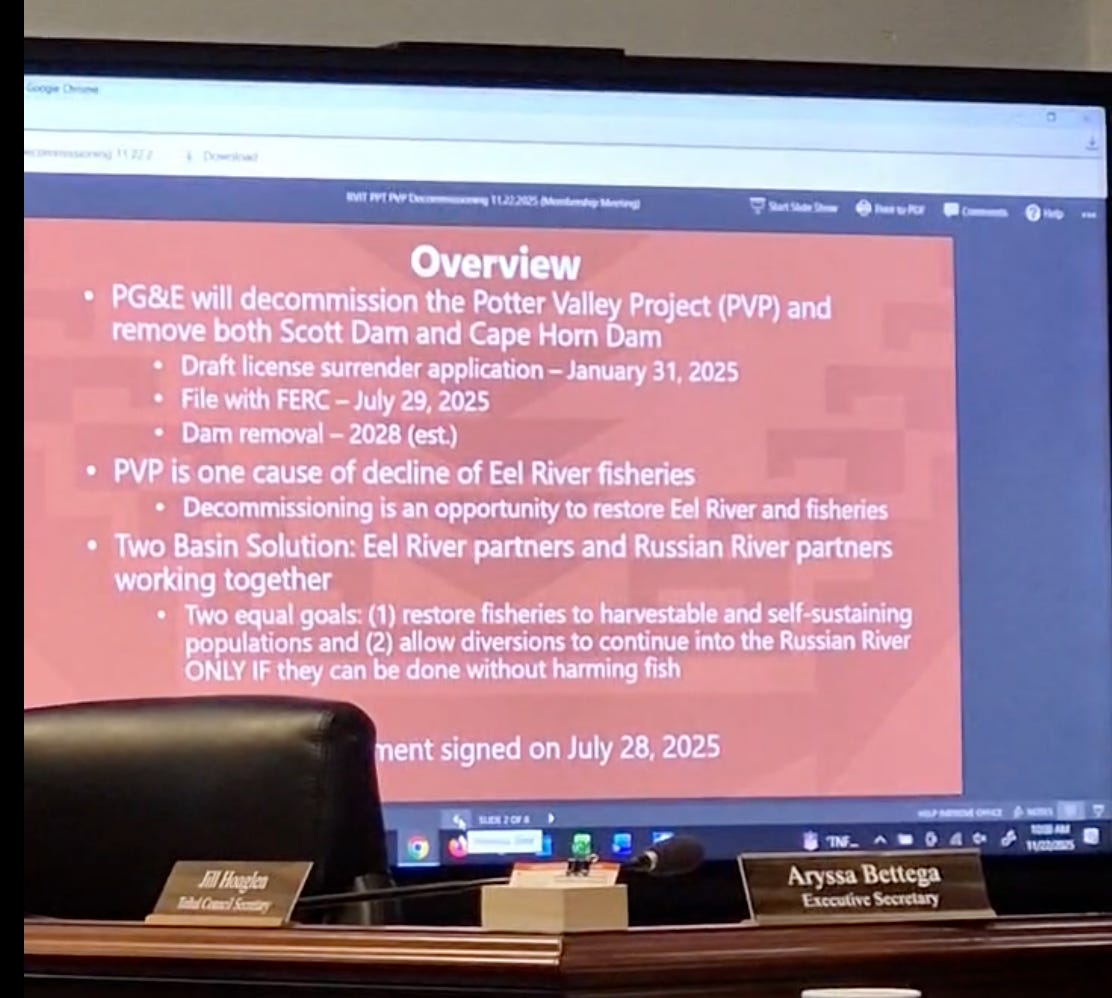
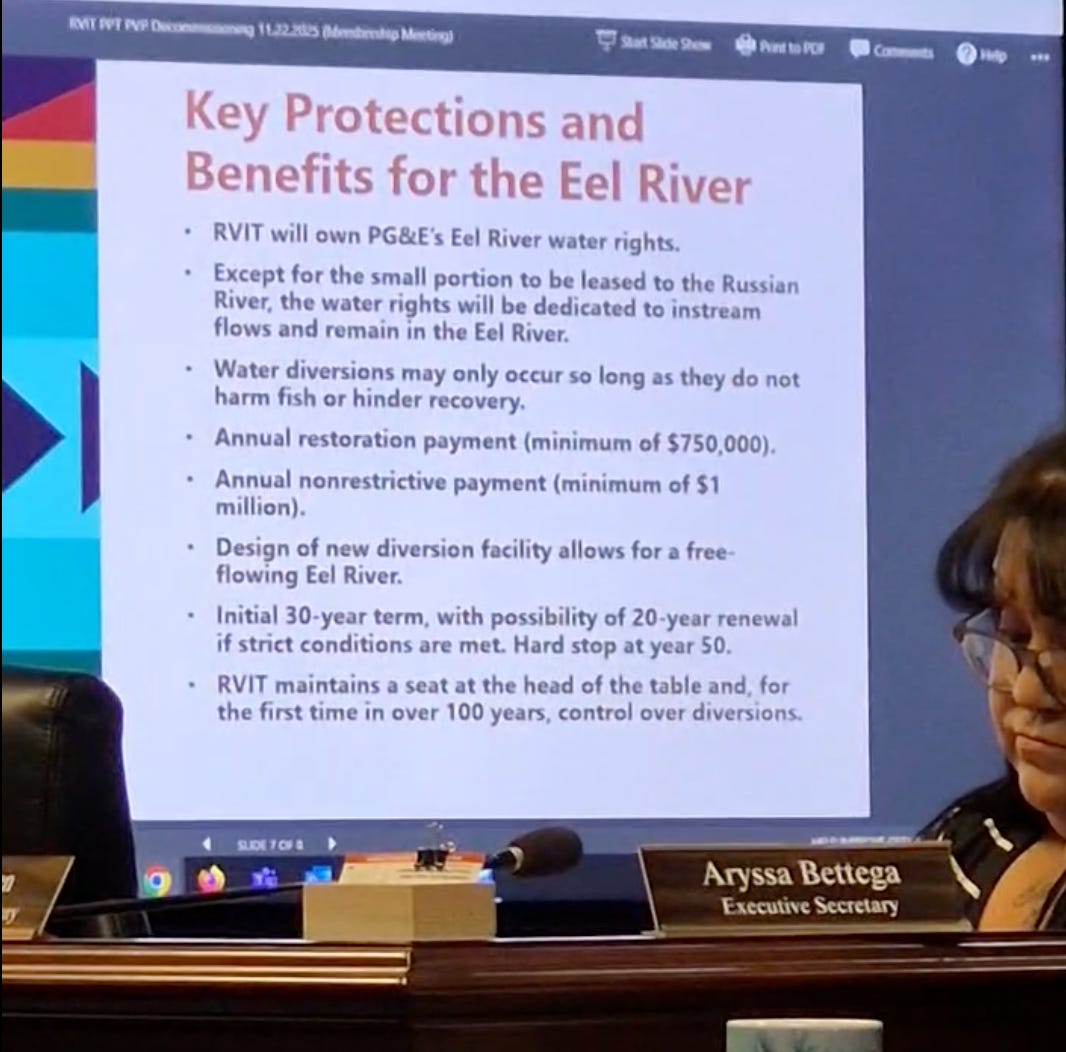
Berkey said PG&E’s decision not to relicense the project presents an “incredible opportunity.” RVIT will lease water rights to a joint powers group called the Eel River Project Authority (ERPA) to supply the thousands of residents who will lose water when dams are taken out. This is marketed as the Two-Basin Solution.
A number of parties came together with RVIT to form the Two-Basin Solution, including Sonoma Water, the Mendocino County Inland Water & Power Commission (IWPC), the California Department of Fish & Wildlife (CDFW), CalTrout, and Trout Unlimited.
Diversions only in winter, and only in good rain years
While the Two-Basin Solution will allow some water diversions back to the Russian River, Berkey says, this will only happen in winter when flows are already high.
“From 1908 to when this new arrangement goes into place, the only entity in the Russian River basin that paid for Eel River water was the Potter Valley Irrigation District,” said Berkey. “Those days are over. People are going to have to start paying. They’re complaining that they’re not getting as much water as they were before. We can argue about that but the key thing for us—for Round Valley Tribes and others concerned about Eel River fisheries—is, during the summer months when the river is at its lowest flow and you need to keep water in the river so that it doesn’t get too hot for salmon in the river, no diversions can occur. The diversions are only going to happen in the wintertime when the flows are really high and even if they’re not high enough in the wintertime no flows can occur.”
He concedes that RVIT would have preferred to stop all diversions completely, but depicts the agreement as strategic.
“PG&E would not convey its water rights to the Round Valley Indian Tribes unless we had this agreement in place,” he said.
RVIT has right to review fish impact every five years and stop sending water
Berkey cites another “key condition” for diversions: If the tribe’s scientists conclude sending water to the Russian River is hurting fish in the Eel River, diversions must stop.
Under the agreement, RVIT has the right to assess fish impact every five years.
“If we conclude, we show, that the evidence shows that fish are continuing to decline and not recovering, then those diversions have to stop,” he says. “Diversions will continue, but subject to strict control.”
Source: Public Facebook Live posted by attendee
Potter Valley cattle rancher Matt Delbar says this contradicts what the community was told by IWPC attorney Scott Shapiro at a public workshop held November 25.
“Suggesting that any salmon decrease could lead to the end of the diversion, not just a decrease caused or even correlated to the diversion, this is different than what the IWPC lawyer has to say,” Delbar says.
Casey Burris is another rancher in Potter Valley who feels blindsided by Berkey’s comments.
“We were told if we did not come to an agreement with Round Valley then no diversion would be allowed and Round Valley would control it,” he says. “I did not know that in five years we could lose the entire investment if the fish count goes down. They never told us that. I think they have signed our death warrant.”
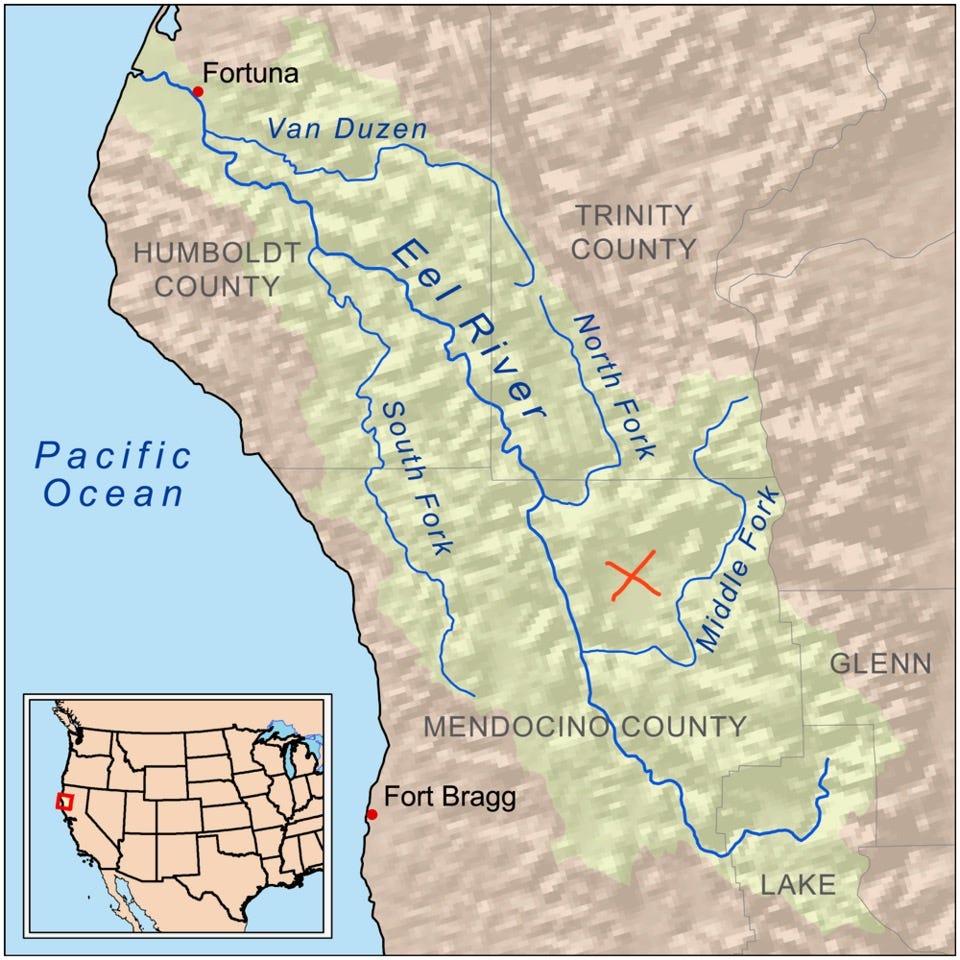
Another Potter Valley rancher points out that while Round Valley has an interest in the Middle and North Forks of the Eel River, it is “completely disconnected” from the Upper Eel, where dams are located.
“And it only minimally touches on the Main Branch of the Eel, into which the Upper Eel drains,” he adds. “It has much less involvement in the Upper Eel than a number of other tribes.”
The Potter Valley Tribe recently filed a motion to intervene in dam removal, saying they have been kept out of the conversation entirely. Lake County, where Lake Pillsbury is located, is home to seven federally-recognized tribes and has also been shut out of stakeholder discussions.
RVIT set to receive $1 million per year for water rights
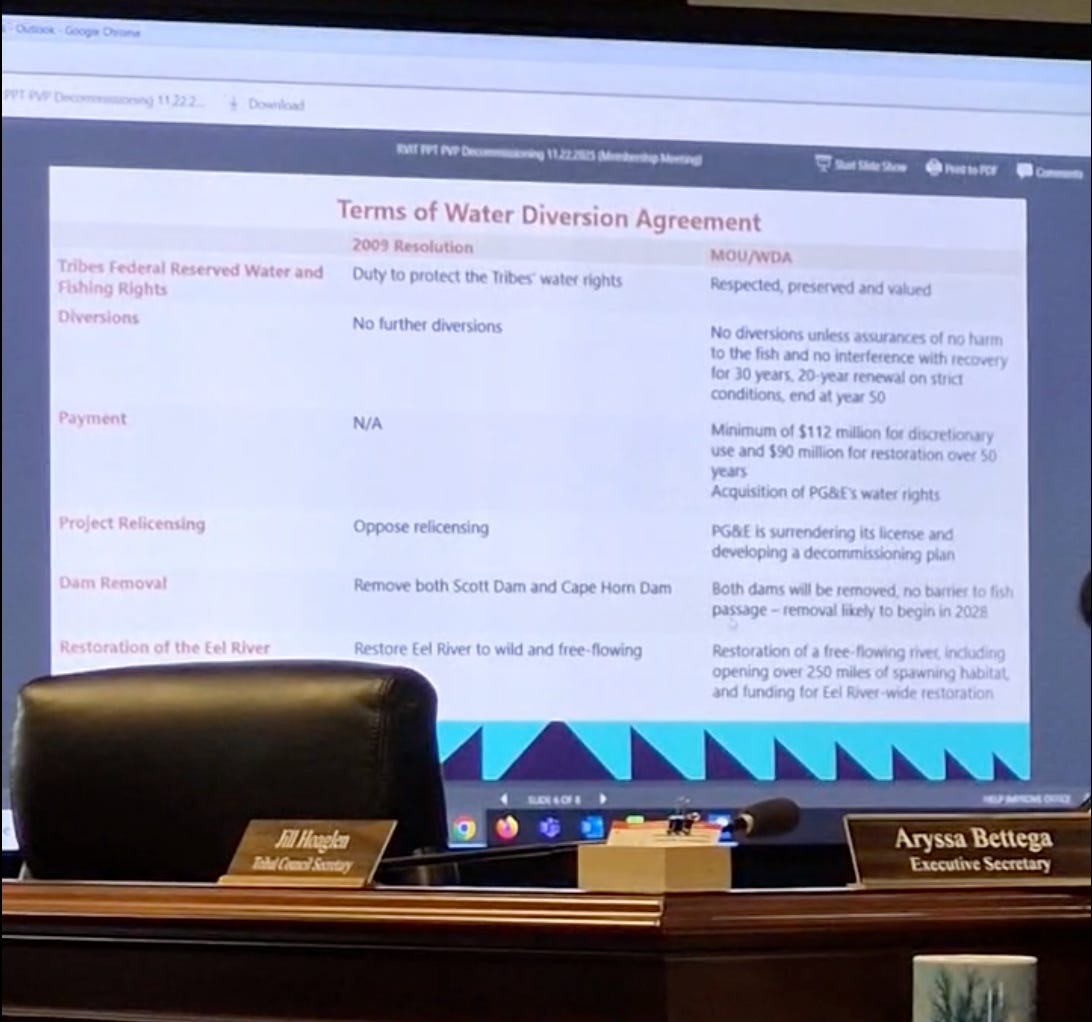
Under this agreement, ERPA will pay the Round Valley Tribes $1 million every year for the duration of the 30-year water lease. There will also be an annual $750,000 restoration payment, which Berkey says will most likely be managed by a “new non-profit.” RVIT will be on its board of directors, he predicts, along with CalTrout, Trout Unlimited, and Humboldt County. River restoration will require a lot of help, Berkey told the group, because the Eel River has been “suffering” since 1908.
A tribal leader assured members the tribe will be paid even if water diversions are cut.
“If there’s years that we don’t get much rain, we go back into a drought, they still have to pay that money to us by contract whether they get [inaudible] water or not,” he said.
“There’s gonna be millions of dollars of money coming in”
“The other big part of this is that, as part of this Two-Basin Solution, there’s gonna be millions of dollars of money coming in to the Eel River Basin for restoration,” Berkey said. “We’re working hard to make sure that your priorities are front and center in that process.”
There have already been grants made. CDFW has awarded $9 million to Eel River restoration.
“Round Valley Indian Tribes are going to be getting—and you can decide how you want to use this—$2.5 million of that.”
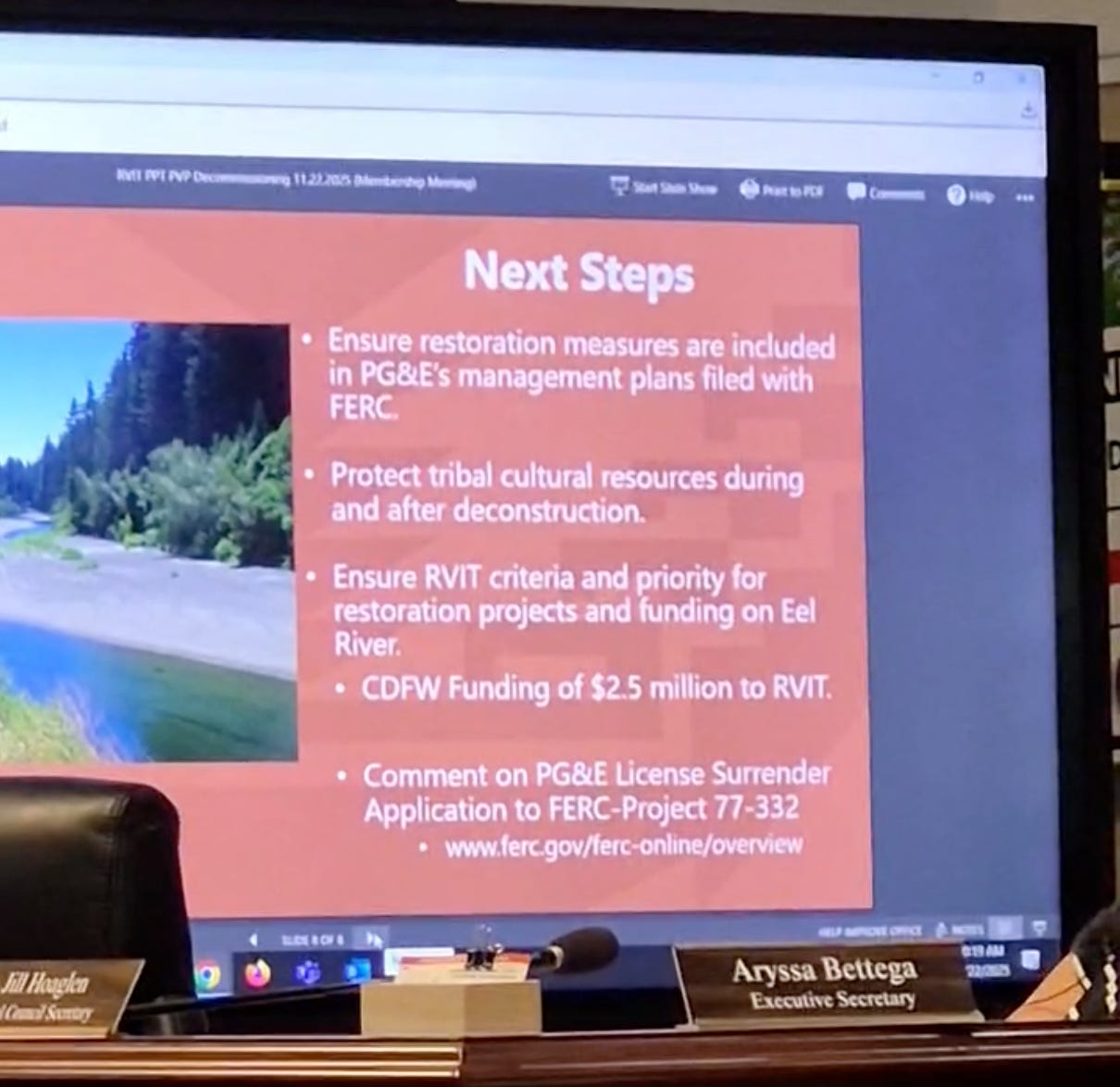
Berkey says the rest of the money will be divided between other entities, including NGOs like CalTrout and Trout Unlimited.
Wyatt Smith, a fish biologist and program coordinator for RVIT, followed up with a presentation on how the money could be spent, including a large chunk on “studies” in Potter Valley. One tribal member asked why any money would be spent in Potter Valley.
“This is the beginning of funding, not the end,” Smith responded. “It’s hopefully going to set us up to get a bunch more money.”
Sonoma and Mendocino must raise $25 million in 30 years to keep diversions coming
Berkey says the diversion rules he lists, including five-year assessments, are baked into the Two-Basin Solution.
“If they violate them we can sue them,” he said. “And we will.”
Berkey also informed the group that Sonoma and Mendocino counties must raise and pay $25 million within 30 years in order to keep diversions coming.
“If they don’t raise that money, the diversions stop in 30 years. Period, the end. That’s an absolute condition.”
Berkey added that the Eel River community’s interests are aligned with PG&E’s in “getting those dams out as fast as humanly possible.”
He urged tribal members to submit comments to the Federal Energy Regulatory Commission (FERC), which will decide on PG&E’s dam surrender plan. Berkey dismissed any chance that FERC would require PG&E to keep the dams in place.
“The key thing is, unless Congress steps in—and that’s, you know, in this political climate that’s not completely out of the question—unless Congress steps in, those dams are coming out.”
He thinks that could happen as early as 2031.
Note: The November 22 RVIT meeting was recorded and streamed publicly by an attendee on a Facebook profile, where it remained publicly accessible as of publication. Quotes here are based on our transcription of the video; minor discrepancies may exist due to sound quality or unclear speech.
Read more:
URBAN NGO SILENCES RURAL VOTERS: San Francisco-based org blocked Lake County from dam removal talks

Cal Trout, a green group based in San Francisco, blocked Lake County from talks to assume local management over two fated dams, Supervisor Eddie “E.J.” Crandell revealed in an interview released Wednesday.
Destroying the Potter Valley Project Won't Save the Salmon: 8 Truths About What Happened to the Eel River

The claim that the Potter Valley Project is the reason for the downfall of salmon and steelhead fisheries in the Eel River is far short of the WHOLE STORY.
Potter Valley Tribe says they have been kept out of dam removal talks

The Potter Valley Tribe has filed a motion to intervene in plans to surrender the Potter Valley Project.
Dam removals devastated the Klamath. Will agriculture take the fall?

I am a rancher in Siskiyou County, California, home to three of the four hydroelectric dams that were recently destroyed on the Klamath River. I’m also a freelance journalist who has written about prospective Klamath Dam removal for 10 years.
WHAT SEISMIC RISK? State reports from 2023 find Potter Valley dams "safe for continued use."

Newly-revealed state reports from 2023 show that the Potter Valley dams in Northern California, slated for removal, have been deemed seismically sound by the California Department of Water Resources Division of Safety of Dams, despite politicians an…
“This shuts us down:" Potter Valley ranchers say PG&E cut water without warning amid dam removal fight

Water cutoff hits rural town in the middle of harvest and fire season
PG&E asks feds to make water cuts on Potter Valley farmers & ranchers permanent

Pacific Gas & Electric (PG&E) has asked the federal government to formalize agricultural water cuts in Potter Valley. Back in August, these restrictions blindsided farmers and ranchers who were in the middle of harvest and on the cusp of fire season.
Nothing like five members of a tribal council and their lawyer to finally get to the heart of the matter. (BTW, Tribal Council’s are like going to a dysfunctional thanksgiving dinner where no one gets along and hold long term personal grievances, every day) The environmentalist of the RV Nation have figured out that there is money in water. They must have watched John Houston’s character in the Movie Chinatown explain to Jack Nicholson’s character the nature of the water rights fight in Los Angeles. If one looks at the aboriginal use of a water system, they would be astonished at what they would find. Because the tribes/clans were very small and mobile, they would camp where food and shelter were plentiful and when the situation changed, like they ran out of food and clean water they moved upstream or down stream. Today if one contests their poor to nonexistent stewardship of a river system in ancient days, they are considered a racist or worse. However they never stewarded anything, they used it differently and basically had marginal impact on the environment. Fast forward, to a a fast talking environmental lawyer, and his ability to stir the pot and presto chango, we want our fishing rights back, and we get a fortune for controlling the water flows to 600,000 people, ranches, farms, orchards, etc. How does a water magnate make a small fortune? He starts with a big one. The RV nation thinks it is taking the right road. Instead they are taking the easy road. They will be back to Jump Street when the lawyers, grifters and cheats steal their water rights cash flow, and they will steal it, crooks know a good mark when they see one. They could take the hard road, as to be part of the new Potter Valley Electric Power Coop, creating jobs in the trades of hydroelectricity and distribution of power to the communities, in their own service territory. PG&E is terrified of such a thing of course. It would demonstrate just how corrupt and what a pathetic regulated public utility they are, and the politicians in Sacramento would look equally as bad for supporting the dams removal. One question that comes to mind, where are all the vineyard owners in all this, it seems there are some pretty high end wine makers in the two counties. Have they cut a special deal already, or are they getting rolled up with everyone else? Imagine the horror on Nob Hill. when there is no 2032 red wine coming from the Sonoma vineyards. Lastly since when do the exaggerated fishing rights claims of 5,000 members of a local tribal nation take precedent over the greater good of the 600,000 residents who will have their lives and businesses affected. Dam removal is always a zero sum game for everyone except that fast talking lawyer representing the nation. He is already talking to the best architect’s around and developing plans for his new 20,000 square foot home and abutting vineyard. Yep. We are all in this together. Just ask M.r Berkeley he will tell you so! You can trust him, he is not like the others in the law firm of Dewy Cheatam and Howe!
It’s really not about the fish after all…
It’s a corrupt scheme removing the stakeholders from water rights , drying up downstream communities using the Tribes as leverage … then back channeling Federal funds to back room deals , NGO’s , dubious contractors , and the RV Tribe …. It’s Not really about the salmon
Buckshot Bill