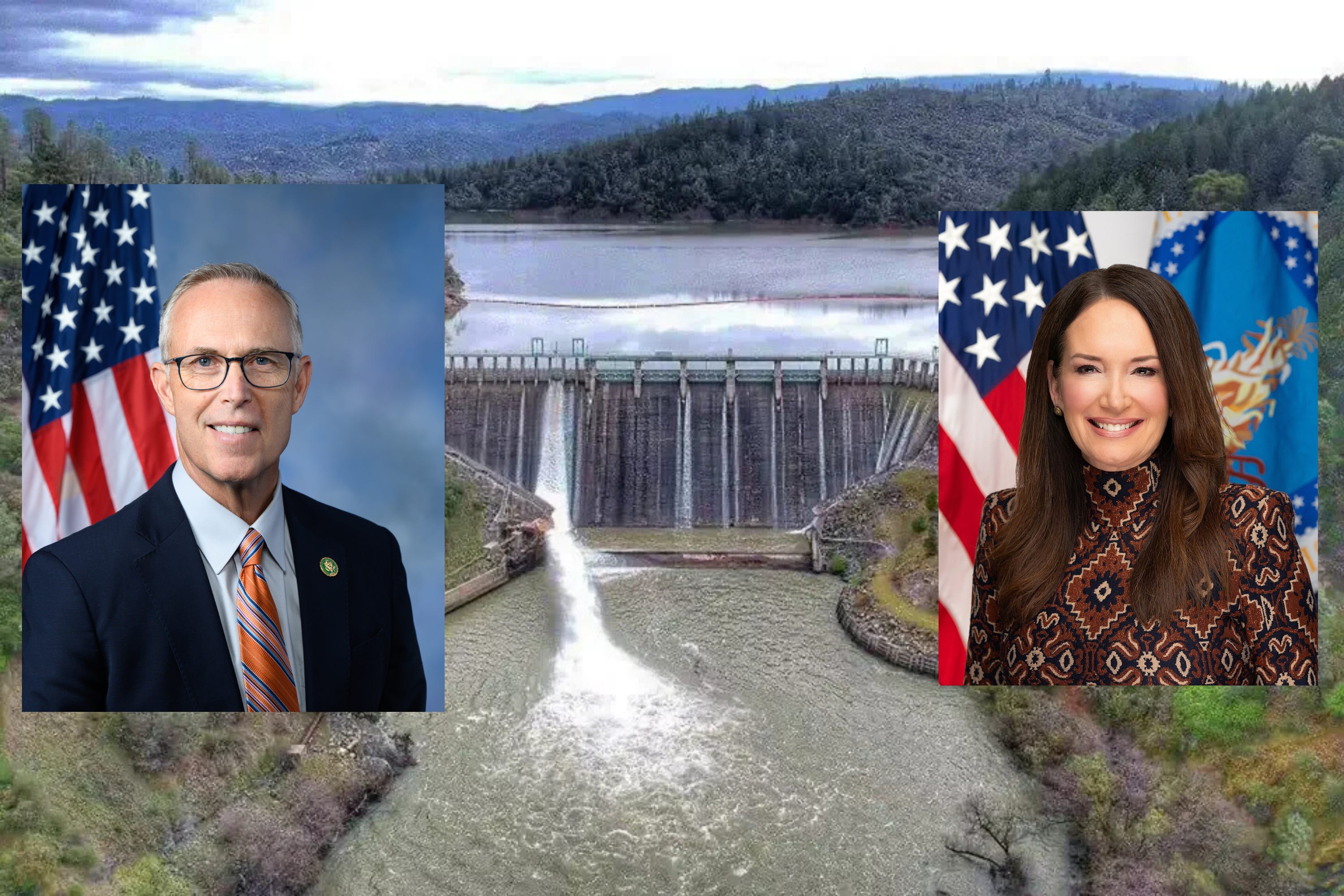
Secretary Rollins Fires Back at Huffman's Investigation Into Potter Valley Dams
The USDA chief is not backing down: She says the federal government has a stake in keeping Potter Valley's water infrastructure alive, and PG&E must take any serious buyer seriously.
Agriculture Secretary Brooke Rollins has responded to a congressional investigation launched by Rep. Jared Huffman (D-CA) into the USDA’s efforts to stop proposed dam removals in Northern California.
Last month, Rollins announced that a buyer has expressed interest in the Potter Valley Project, an orphaned hydroelectric system that delivers water to 750,000 residents, largely in Huffman’s district. PG&E, the project’s owner, has decided not to renew its hydroelectric license and has asked the federal government for permission to tear down Scott Dam and Cape Horn Dam.
Huffman, who is the ranking Democrat on the House Natural Resources Committee, then opened an investigation into the USDA’s involvement.
“The involvement by these federal agencies, the District, and perhaps others in a scheme to take over the PVP and to ‘restart/expand’ its defunct hydropower operations revives a long and contentious history,” Huffman wrote. “Accordingly, my constituents and I are acutely interested in all of the details surrounding your efforts relative to a potential purchase or acquisition of the PVP and any plans or proposals to operate the project for the benefit of the District and perhaps others far from the Eel and Russian River basins.”
In her response, Rollins outlined the federal government’s interest in preserving the project and its ongoing ability to serve North Coast residents.
“The Federal government has a clear interest in ensuring that any potential buyer is given serious consideration by PG&E when it could ultimately keep important water and energy infrastructure, serving hundreds of thousands of people, in place,” Rollins wrote.
Her letter is included in full below.
Secretary Brooke L. Rollins
Washington, D.C. 20250May 29, 2026
THE HONORABLE JARED HUFFMAN
Ranking Member Natural Resources Committee
United States House of Representatives
2330 Rayburn House Office Building
Washington, D.C. 20515Dear Ranking Member Huffman,
Thank you for your April 28, 2026, letter regarding the Potter Valley Hydroelectric Project in California which is owned by Pacific Gas and Electric Company (PG&E). The Trump Administration remains deeply concerned about the profoundly negative and irreversible impact that the proposed decommissioning of the Scott and Cape Horn Dams will have on the area’s rich agricultural heritage, local communities, and the estimated 750,000 residents whose survival depends on a stable water supply – things that will be lost if the dams are ultimately removed.
For over a hundred years, legacy farmers in Potter Valley and surrounding counties have put water from the Eel River Basin to beneficial use after first using it to generate electricity. This has been a symbiotic relationship among farmers, power generators, and the environment. Unfortunately, under the radical leadership of the State of California, the needs of fish have been prioritized over the needs of the farmers and ranchers who feed our nation and the rural communities and businesses that need water access to survive. It is gravely concerning that our Nation’s largest food producing State has chosen special interests at the expense of its farmers, ranchers, and communities; the State’s continued effort to remove important water infrastructure compromises California’s resilience to drought, wildfires, and extreme weather.
The President’s Administration is committed to good governance and evidence-based decision making, rejecting the kind of rigid ideological policies that threaten real harm on California communities. When President Trump signed Executive Order 14213, Establishing the National Energy Dominance Council, and Executive Order 14154, Unleashing American Energy, he affirmed his commitment to expand all forms of reliable and affordable energy production. Importantly, this Administration recognizes ideologically driven actions have impeded the generation of reliable and affordable electricity inflicting high energy costs upon rate payers. Fifteen to twenty percent of California’s State generated energy portfolio is hydropower. High hydropower utilization improves reliability and reduces blackout risk, especially in drought years. Reducing California’s electricity reliability at the expense of ratepayers further stresses the State’s fragile electrical grid and energy affordability for all Californians. The estimated cost of removing the Potter Valley Project is between $500 million and $1 billion – likely to be borne by PG&E rate payers and to the detriment of any person who currently enjoys water supply from the project.
According to the most recent census of agriculture, the counties of Lake, Mendocino, Sonoma, Humboldt, and Marin have a combined total of over $1.4 billion in sales of agricultural products. That is well over $4.2 billion in broader economic activity based on a regional typical multiplier of $3 to $1. Economic activity will be lost if water access is eliminated. Furthermore, eliminating these dams will degrade water quality and drinking water safety for downstream communities, farms, and ecosystems. It will diminish the capacity for wildland firefighting in one of the most fire-prone regions of the country. It endangers groundwater wells and grazing allotments, eliminates key recreation resources, and places at risk hundreds of millions of dollars in USDA-backed loans, crop insurance programs, conservation investments, and rural development projects. There are also few, if any, environmental benefits to be gained from the removal of the project, considering the dams have been in place for over 100 years and currently benefit protected watersheds with cold water releases.
Wildfire is of significant concern due to the history of devastation in this region. Lake Pillsbury provides a crucial water supply needed for fighting major forest fires in the area, and is a critical and life-saving asset that was used extensively to combat three of the largest wildfires in State history – the 2017 Sonoma Complex Fire, the 2018 Mendocino Complex Fire, and the 2020 August Complex Fire. The 2017 Sonoma Complex fires alone were the most destructive in State history at the time, with over 110,000 acres destroyed, $9 billion in insured losses, and significant loss of life all within the service area of the Potter Valley Project. This alone warrants thorough examination of the surrender of the system and any proposed alternatives. Additional information related specifically to the utilization of the Potter Valley Projects as relates to wildland fire fighting and U.S. Forest Service assets in the area can be found in the intervention submitted to the Federal Energy Regulatory Commission (FERC) by USDA.
PG&E frequently touts its commitment to operating cost savings and improved resilience for 16 million rate payers across California. This underscores the organization’s fiduciary responsibility to its ratepayers to pursue strategies that reduce costs while providing reliable energy. In this context, engaging with a prospective buyer for the Potter Valley Hydroelectric Project represents a prudent avenue for transferring assets that may no longer align with PG&E’s long-term objectives. It could also serve the best interests of customers by mitigating the substantial financial liabilities associated with dam removal – costs that could reach upward of a billion dollars.
The ongoing push for full removal of the Potter Valley Project stands in direct contrast to the California Legislature and Governor Newsom’s statewide commitment to adding nine million acre feet of new water supply by 2040, as it would eliminate critical storage and diversion infrastructure at a time when California urgently needs every available tool to bolster reliable water supplies for agriculture, communities, and ecosystems.
The Administration will entertain the Elsinore Valley Municipal Water District and any other legitimate party expressing interest in purchasing the Potter Valley Project and operating it in a manner consistent with what agricultural producers and communities have relied upon over the last century. Keeping the infrastructure in place and restarting hydroelectric generation has the potential to advance the President’s energy dominance agenda and will undoubtedly secure the water supply needs of the hundreds of thousands of citizens in rural California who currently use the water diversions.
There are many outstanding questions and considerations surrounding the proposed surrender and decommissioning of the Potter Valley Project. For a detailed examination of these concerns, please refer to the formal interventions submitted to FERC by the Department of the Interior and USDA.
A government by the people should be for the people. The Federal government has a clear interest in ensuring that any potential buyer is given serious consideration by PG&E when it could ultimately keep important water and energy infrastructure, serving hundreds of thousands of people, in place.
If you have any questions, please have a member of your staff contact the Office of Congressional Relations at (202) 720-7095 or ocr@usda.gov.
Sincerely,
Brooke L. Rollins
Secretary
U.S. Department of Agriculture


I hope Ms. Niman gets some big donor dinero in her congressional seat bid against Huffman.
Huffman and PG&E’s relationship with him need an FBI and or DOJ investigation. No doubt the unholy alliance with PG&E and TNP are enormous conflicts of interests. In the meantime the people to need to rally and speak up loudly of they want to save their water and hydroelectric power. No one is coming to save you, so gear up and get busy advocating.