Farmers say FFA is pushing faith out of the organization
Two Christian groups were banned from the Texas FFA convention. That's just the latest example in a trend that starts at the top, advocates say.

For almost 20 years, students attending the Texas FFA Convention in Fort Worth have stopped by the Fellowship of Christian Farmers International (FCFI) booth. Volunteers pass out beaded bracelets depicting the Christian gospel—the “Wordless Message”—and talk with students about faith, mission trips, and service opportunities. Every year, retired ag teacher and FFA advisor Art Free looked forward to seeing the kids. Some would stop by the booth to show him they were still wearing their bracelet.
But this year, when FCFI applied for its usual booth, something had changed. There was a new policy, and they were no longer welcome.
Free was blindsided.
“I almost cried when they told me,” he says. “I couldn’t believe it.”
FCFI is one of at least two Christian groups barred from exhibiting at the 98th Annual Texas FFA Convention due to a new policy that prohibits groups promoting “specific political or social ideologies.”
This mirrors policy at the National FFA Convention and, according to FCFI, several other state chapters. Texas is only the latest to adopt the policy.
Christian groups banned from holding booths
In an email sent April 6, FCFI was told exhibit management had “determined that your presence at our events is affected by this new change.”
The American Federation of Cowboy Churches was also denied a booth. The email, reviewed by UNWON, cited the same reasoning: The new policy prohibited its inclusion. It would have been the group’s first year at the convention.
A nonprofit founded in 1985, FCFI exists to serve farmers and ranchers through evangelism, outreach, and disaster relief. The group is headquartered in Kalamazoo, Michigan.
Free says when he called to check on FCFI’s application status, Texas FFA referred him to the Agriculture Teachers Association of Texas (ATAT), which manages the convention. An ATAT special projects coordinator sent the April 6 email, and a follow-up email affirming the decision was signed by both Texas FFA and ATAT.
It is unclear whether ATAT made the call to exclude the Christian booths, or Texas FFA, or both.
ATAT did not respond to a request for comment. Texas FFA Association’s Executive Director Jackson defended the policy in emails to Free but did not respond to UNWON’s questions.
“Respectfully, disagreeing with Texas FFA’s exhibitor policy does not make this a matter of religious discrimination, nor does it mean that Texas FFA has denied Christianity,” wrote Jackson in email correspondence with Free reviewed by UNWON. “Texas FFA has not denied Jesus, Christianity, or any other faith.”
Texas FFA has not explained what prompted the new policy or how “specific political or social ideologies” are defined. Nor has the organization said whether non-Christian religious organizations have applied for booths. There is no publicly-available record of a vote or action by the Texas FFA Board of Directors approving this policy change.
“The very best of America”
Free is 66 years old. He was an FFA member in high school and attended the Texas FFA Convention in 1978. He went on to teach ag for 20 years and serve as an FFA advisor.
“I tell everybody, if you want to see what is absolutely right with the United States, go to the Texas FFA Convention,” Free says. He spoke by phone from his farm after stepping away from hauling hay with his grandkids. “To me, Texas FFA is the very best of America.”
He wants to make it clear that his criticism has nothing to do with the organization or the students. He is concerned about the leadership’s decision.
“We’re not running down Texas FFA,” he says. “My grandkids are just a couple years away from being in Texas FFA. I want it to be the same great organization that it always was.”
After learning FCFI was denied a booth, he twice asked to attend the Texas FFA quarterly board meeting at Tarleton State University and speak during its public comment segment. Both of his emails were ignored. He hopes the issue is merely procedural: he emailed as soon as he learned of the board meeting, 10 days beforehand, but knows the board requests all submissions 12 days prior.
Unable to get a response through the board, Free decided to take his message directly to the students.
Texas FFA explains its reasoning
Free made a video explaining the exclusion. FCFI published it online. Then Free sent it to all the students serving as Texas FFA state officers.
“I know you are very busy preparing for your final convention but please take a moment to absorb this message,” he wrote.
Right away, he heard from Jackson.
“The officers are extremely busy preparing for their work during the 98th Annual Texas FFA Convention, and I think you will likely understand my disappointment that this burden was placed on them,” she wrote in an email.
Free told her that while he would respect her decision, FCFI wasn’t going to abandon the students.
“We have no intent of doing anything that will negatively affect Texas FFA,” he wrote. “We will be in Ft Worth on the street not for a protest or to cause any problems for FFA. We will simply be sharing the Gospel of Jesus and presenting opportunities that our organization offers, as we do at many locations around the world. If we are asked why we are not inside we will explain the situation from our perspective.”
Jackson replied. She said the organization was attempting to take a non-discriminatory stance.
“I would encourage you to place yourself in our position and consider the implications of allowing one religious organization to exhibit while attempting to deny that same opportunity to others,” she wrote. “Our responsibility is not to determine which religious organizations should or should not be represented at convention, but rather to ensure that the event remains focused on agriculture and leadership.”
Jackson did not respond to an email asking if groups representing other religions applied for booths at the Texas FFA Convention.
“I see where she is coming from,” Free says. “I have no idea if other religious groups want to be there. But if so, how do I put this? I would let Jesus stand against anybody. If there’s another group that comes in and wants to pay the money to have a booth, let them.”
Friends of the Rising Sun
What happened in Texas is not an isolated event, according to Friends of the Rising Sun, a group of former FFA leaders, members, teachers, and advocates who say they are concerned about the direction of the organization.
The group takes its name from one of the five symbols in the FFA emblem. Its members say FFA helped shape their lives and careers, and that they are speaking out because they want to preserve what they believe to be the soul and purpose of the organization.
Friends of the Rising Sun has argued that National FFA has shifted its focus away from training agriculturalists to social issues. They say leadership is discouraging public expressions of Christian faith.
“Sadly, this exclusion follows a similar decision by the National FFA,” says a past national officer candidate. He asked to remain anonymous. “It’s deeply troubling to hear reports of groups being excluded because of their Christian beliefs, and student references to faith being discouraged.”
He is a member of Friends of the Rising Sun. The organization has a growing reach—its Facebook group has more than 1,000 members.
A broader fight over FFA
Free says FCFI has been barred from exhibiting at the National FFA Convention, as well as conventions in several other states, including Illinois, Ohio, and Iowa.
To the former national officer candidate, this tracks.
“It begins to trickle down,” he says. “What happens at the national level will get to the state level and chapter level eventually.”
In 2020, he alleges, a national officer coordinator instructed national FFA officers to stop praying publicly or including Scripture in speeches connected to FFA. Vendors at the National FFA Convention, held near the organization’s headquarters in Indianapolis, have been asked to take down merchandise that references Jesus—even the famous Paul Harvey “So God Made a Farmer” speech is verboten, he claims.
“Parents don’t want to believe this could happen to FFA, but I tell them, just look at the Boy Scouts,” he says. “FFA has gotten away from its foundation as an organization. A darkness has come over Indianapolis.”
Congress investigates National FFA’s link to Chinese-owned company and DEI push
National FFA is currently in the middle of a congressional investigation.
House Ways and Means is examining the nonprofit’s partnership with Syngenta, an agriculture company held by Chinese state-owned Sinochem, and that company’s role in pushing FFA to adopt diversity, equity, and inclusion (DEI) programming.
UNWON reached out to National FFA with a detailed list of questions about its exhibitor policy, whether faith-based groups have been denied booths at the National FFA Convention, and guidance given to national officers regarding prayer and Scripture. This story will be updated with any response.


Preaching Jesus “on the sidewalk”
In addition to evangelism and outreach, FCFI coordinates mission trips and disaster relief, particularly in rural areas.
“We try to help the people who fall through the cracks,” Free says. “FEMA doesn’t reach everybody.”
They helped out during wildfires in Nebraska, Oklahoma, and the Texas panhandle last year. They partnered with Farm Rescue and hauled several hundred round bales to Eastern Kansas. They brought in hay and supplies after Hurricane Helene in the Carolinas. They often coordinate with local FFA chapters to deliver support and aid to farmers after natural disasters.
To Free, the most important part of having a booth is connecting with the kids.
“We have a lot of kids that come by year-to-year,” he says. “Our presence affirms their faith. I ask if I can pray for them, and often they ask if they can pray for me.”
The thought of letting these kids down was unacceptable. A self-described “hardheaded Texan,” Free consulted with the city of Fort Worth after his email back-and-forth with Jackson. City code doesn’t allow unpermitted outdoor booths or tables, but nothing stopped him from standing on the sidewalk.
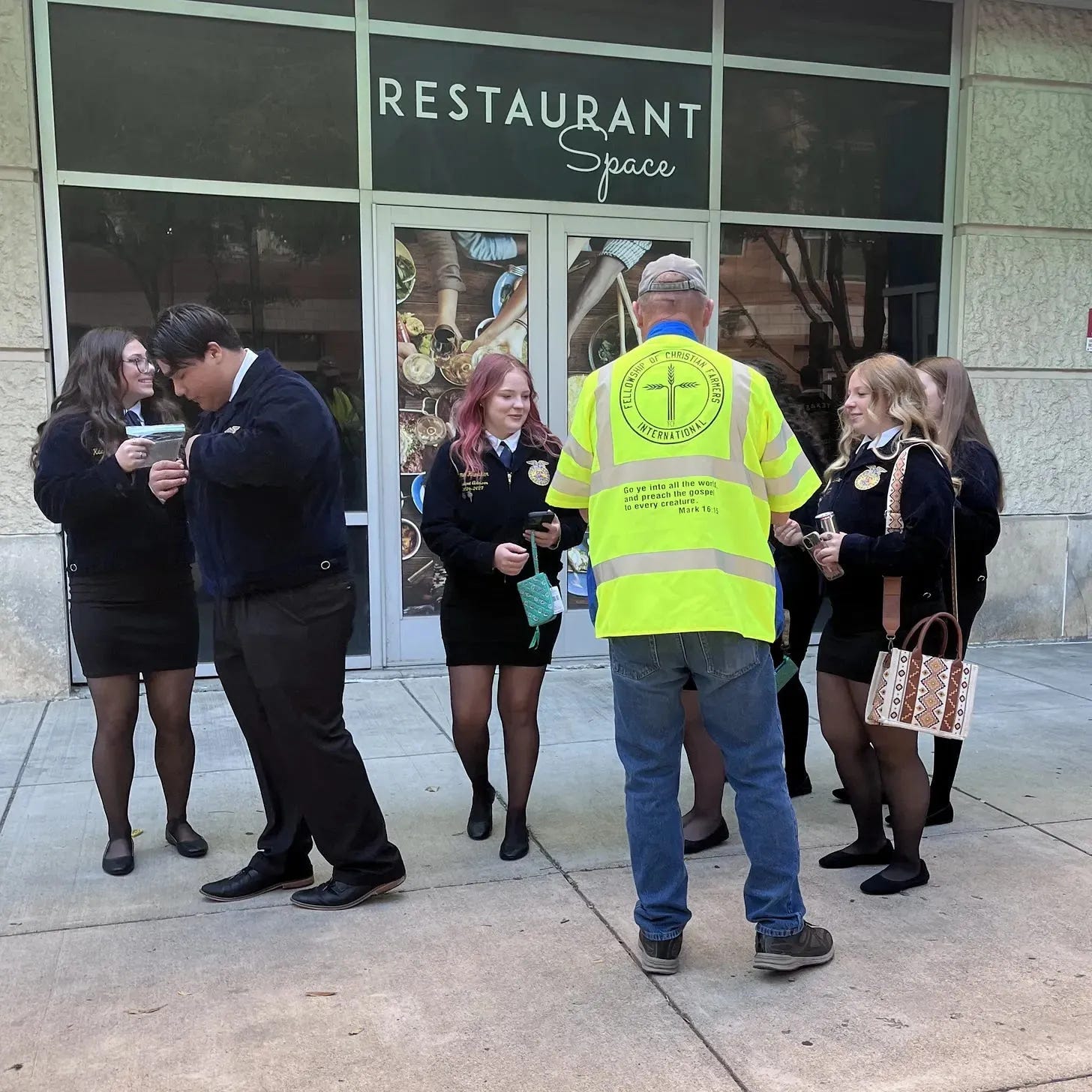
Art, his wife Susan, and fellow FCFI volunteer Jeff Goss came up with a plan. They’d stand outside the parking structure and hand out packets to attendees making their way into the convention center: an FCFI Operator Manual, a gospel tract, a Wordless Message bracelet, a “little Jesus” figure—“The kids like them,” says Free—and a flier explaining what happened and why FCFI would not be found at their usual booth.

When Free informed Jackson of their plan, she told him she was “disappointed.”
“While you certainly have the right to share your perspective in a public setting, I am disappointed by your stated intent to explain this matter to our members and guests during our convention,” she wrote. “Doing so has the potential to create confusion, distract from the event’s purpose, and undermine confidence in the leadership and mission of Texas FFA.”
But Free wanted students to know that FCFI hadn’t chosen not to attend.
“I wanted Texas FFA to know that we did not abandon them, we were disinvited.”
Susan and her grandkids packed 1000 ziplock baggies. They were there the day the convention floor opened—Wednesday, July 8. Susan, Art, and Jeff stood on the sidewalk in the Texas heat and hoped they’d be able to pass out some packets.
They ran out of all 1,000 packets by 10 a.m.
The group bought more sandwich baggies at Walmart, overnighted supplies from Amazon, and packaged more handouts in the hotel room.
By the end of the convention, they’d given away 3,000 packets to FFA students. In a typical year, they give out about 800 to 1,000 bracelets total at the FCFI booth, Free says.
“What Satan meant as a stumbling block for FCFI was turned into a mighty blessing by God,” he says.
By the second and third day, attendees were stopping the FCFI volunteers to talk. They’d had a chance to read the flier the day before.
“They started asking us, ‘What is going on here?’” says Free. “And we’d tell them.”
In one of her emails, Jackson asked Free to “focus on sharing your message in a positive and respectful manner rather than creating conflict, confusion, or doubt about the leadership or decisions of our organization.”
But Free says the kids have a right to know.
“It’s their organization.”


How can it be in a free country?
As a former FFA member and State Farmer, I could not agree more with this decision. FFA is not a faith based organization. It’s an agricultural leadership one as the national leadership correctly states. If you include Christianity, then you need to include all the other religions in representation and in prayer - which adds a lot more layers that don’t directly adhere to organization’s mission.
FFA is tied to public schools through their agricultural education programs which should not and do not promote any religion.
The organization does promote good values, community and hard work, and many of us would not be where we are today in life if we hadn’t had FFA.
Religious beliefs are personal and a lifelong journey, and they should be explored outside the FFA organization.