
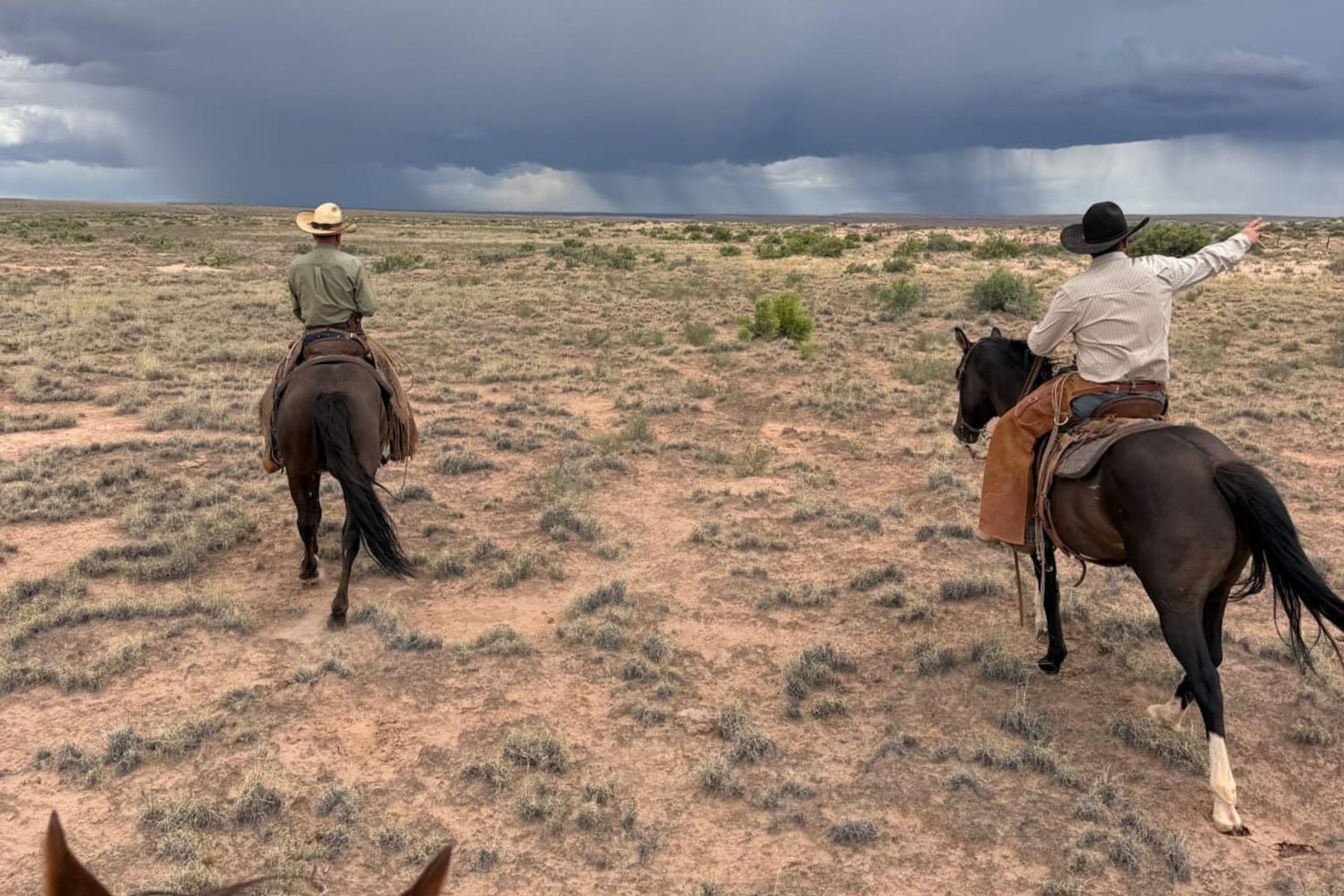
"Pay-to-play": How a nonprofit run by county officials recruited Big Wind & Solar to Arizona ranch country
Did a European energy company just happen to find Casey Murph? Or were they invited?
Days after fifth-generation Arizona rancher Casey Murph raised the alarm about a foreign solar company trying to access his family’s grazing allotment, he found himself on a phone call with the Secretary of Agriculture. She promised to help.
Then on Wednesday, Murph met with representatives from the Arizona State Land Department. He had first heard from Orsted, the European company interested in building a solar project on his land, when they asked to get through one of his locked gates. State officials told him the company has enormous power.
“Orsted has the full resources of the nation of Denmark, money is not an object,” Murph says. “If they want access and have all the time in the world to get it, they can just pay off whoever adjoins the site and get access.”
He says Arizona’s government has been extremely accommodating to developers.
“Seems to me that the state is bending over backwards to allow these solar conglomerates all the leeway in the world to get everything lined up to get the project approved,” he says, “But no one is bending over backwards to help the rancher stay in business.”
It turns out these developers may not have discovered Arizona’s White Mountains by chance. They were invited, and local officials laid out the welcome mat.
County records and corporate filings reviewed by UNWON suggest a nonprofit operating out of Navajo County offices used public resources to recruit international developers, inviting them to build their wind and solar installations in Arizona ranch country.
On paper, the organization no longer exists.
Selling Arizona ranch country to the world
Business filings show REAL AZ shut down on October 17, 2024. But its website is still active, and county financial records reviewed by UNWON indicate REAL AZ continues to receive membership dues from the very companies whose projects it solicits.
According to community researchers, virtually all private corporate donors to REAL AZ have ties to active renewable energy projects in Navajo and Apache Counties.
The REAL AZ board includes multiple county officials, including Navajo County District III Supervisor Jason Whiting, who serves as chairman. Elected to represent a community divided over wind and solar projects, he appears to lead a nonprofit that actively solicits them.
On July 28, 2025, REAL AZ paid the Financial Times of London $25,000. The expense is logged as “Financial Times NO UT – Real AZ FDI Strategies.” FDI stands for Foreign Direct Investment.
If this was for an ad, it wasn’t designed to be seen by local entrepreneurs; it invited the global investment community to take advantage of Arizona’s heavy tax subsidies and wide open spaces for sprawling energy projects. REAL AZ was marketing northeastern Arizona to the world’s money.
But by that point, REAL AZ had been officially dissolved for nine months.
Jason Whiting signed the dissolution paperwork himself.
Local leaders play double duty
In a November 2025 promo video for REAL AZ, Whiting describes the group’s purpose.
“We’re about helping business come into the area and providing jobs and opportunity,” he said.
In 2013, REAL AZ Development Council, Inc. was incorporated with a Holbrook address: 100 East Code Talkers Drive, the Navajo County Administrative Building. Whiting became President and Director on January 28, 2015, according to Arizona Corporation Commission records.
That version of REAL AZ was administratively dissolved for failure to maintain a statutory agent. It was reinstated in June 2017, then dissolved again, for the same reason, in March 2018. This time it stayed closed.
In 2022, Whiting signed articles of incorporation for a new entity: REAL AZ Economic Development Group Inc., also located at 100 East Code Talkers Drive. He is named as incorporator.
REAL AZ collects membership dues from renewable energy companies. As supervisor, Whiting then votes on whether to approve their projects in Navajo County.
REAL AZ chairman positioned to vote on wind & solar projects supported by member companies
On April 28, the Navajo County Board of Supervisors voted to approve West Camp Wind Farm II, LLC, a 500-megawatt AES Corporation wind project—up to 144 turbines stretching over more than 50,000 acres.
AES has been paying dues to REAL AZ since September 2022, says community researcher Kelly Meixler. County financial records show AES made its last recorded payment to REAL AZ in September 2025, eleven months after REAL AZ was dissolved.
Many residents who attended public listening sessions opposed the wind project. As one community member put it on X: “They listened. Then they ignored us.”
County manager Bryan Layton told the board the project was a legal and lawful use of private property.
No one mentioned that the developer asking the board for approval had been writing checks to a dissolved nonprofit run by a supervisor poised to vote, and that county money had paid to recruit such developers to the region in the first place.
A public records request to the county’s Planning Department turned up zero records on water use, dust control, or water quality studies for West Camp Wind Farm II.
The board approved it anyway.
Marketing campaign invites the world to the White Mountains
REAL AZ distributes podcast episodes and videos urging green energy companies all over the world to set up shop in rural Arizona.
The podcast is voiced by an anonymous female host—it sounds AI generated. The county ledger shows a ChatGPT subscription billed to REAL AZ’s fund.
“A region that actually has room to breathe, a place that was practically built from the ground up with business in mind; well that’s Real Arizona,” an episode from February 2026 states. “It’s this economic corridor up in the northeastern part of the state and it’s quickly becoming a very powerful alternative.”
The host goes on to “break down” what makes the region “so interesting” for renewables, listing sunshine, big stretches of “affordable land,” and connectivity to the power grid as natural advantages for developers looking to establish “huge, successful energy projects.”
She invites entrepreneurs to come fill in “gaps in the supply chain.”
“The big developers are on their way, and they’re gonna need everything from transformers and panel frames to cranes and earth movers,” she says. “This is a true ground floor opportunity.”
The podcast tells business owners that what makes this zone—“Real Arizona”—particularly attractive is its lax regulatory environment.
The Navajo County board reshaped its zoning rules in June 2025, according to reporting by the White Mountain Independent. Meixler says ordinances were weakened to fast track wind and solar projects.
Renewable companies pay dues to REAL AZ
Whiting is not the only county official at REAL AZ. Rochelle Lacapa, Navajo County’s Government Relations Director, is named in the original 2022 articles of incorporation as executive director and founding statutory agent. She remained CEO of record until 2023, when she was replaced by Chris Pasterz, Economic Development Director for Navajo County. Pasterz used his county email address as the organization’s contact of record. Hunter Moore also serves as a board member. According to his REAL AZ bio, he previously served as an executive staff member for Navajo County. Another board member, Preston Raban, is the Economic Development Director for Apache County.
Whiting, Lacapa, Pasterz, Moore, and Raban did not respond to requests for comment. But in a Navajo County board meeting in March, Whiting denied any conflict of interest.
“I don't receive any money,” Whiting told the board. “I don't get paid, I don't get any money, nor have I, from Real AZ. So that's not a conflict of interest.”
Arizona Public Service (APS) is the largest energy utility in the state and is state-regulated. APS transferred $600,000 to REAL AZ in February 2022, according to reporting by the White Mountain Independent, over two months before Articles of Incorporation were filed. APS Division Manager Neil Traver then joined REAL AZ’s executive board. APS is required to meet green energy mandates set by the state, and purchases power from these solar and wind projects.
APS spokeswoman Marijka Bastrmajian Cooley provided the following statement:
APS has long partnered with and supported economic development organizations and community initiatives across Arizona, including Navajo County, as part of our commitment to the regions we serve. Our contributions are intended to advance local economic development efforts broadly and are not tied to any specific project. Any suggestion that APS’s support for Navajo County/REAL AZ influenced generation development decisions is false.
When it comes to power purchase agreements, or PPAs, which are agreements to buy power from other organizations rather than generating it ourselves, APS procures those resources through a competitive all-source request-for-proposals process that is both resource-type and location agnostic. We do not direct the type of resource or where projects are built; those decisions are made independently by developers. Through this process, we select the best fit, least-cost option to serve our customers.
We are proud that APS employees serve on nonprofit and community boards in the communities where they live and work. That civic involvement is common across our organization and reflects our commitment to Arizona communities.
Dissolved on paper, open for business
The official Navajo County ledger shows REAL AZ has pulled in about $1 million. Virtually every major renewable energy developer with projects in the area is listed on its website as a member, including AES Corporation, BluEarth Renewables, EDF Renewables, Apex Clean Energy, Clearway Energy, SB Energy, Primergy Solar, Invenergy, RAI Energy, and Repsol.
State law bars dissolved nonprofits from soliciting funds or doing business. In the formal dissolution paperwork REAL AZ signed in 2024, there’s a tax clearance question to determine whether an organization requires a Certificate of Compliance from the Arizona Department of Revenue before dissolving. REAL AZ claimed no such certification was needed, stating the organization had “not commenced activities, does not have members.”
Yet the county’s own financial ledgers show that after shutting down, REAL AZ collected income, contracted with vendors, and maintained an active dues-paying membership that included renewable energy developers, often while their projects moved through county approvals. In the ledger, such payments from governments and businesses are labeled “Real AZ membership” and “Real AZ dues.”
Months after it claimed to cease operations, REAL AZ also signed a nondisclosure agreement with Primergy Solar, a California solar developer. The NDA, dated June 15, 2025 and reviewed by UNWON, was signed by Pasterz. The document established confidentiality in negotiations involving solar and storage projects. The notice address listed for REAL AZ is the Navajo County government building.
Ten days later, county financial records show REAL AZ received a $2,500 payment recorded under “Sunshine Land & Wire LLC – Primergy Solar.”
Dissolving the nonprofit while continuing operations informally through county staff and county resources would eliminate REAL AZ’s legal obligation to file annual reports and financial disclosures with the state.


At a March 24, 2026 Board of Supervisors meeting, Pasterz claimed the decision to dissolve was deliberate. In a slideshow presentation, apparently a response to growing community concern, Pasterz told the board that beginning in October 2024—the same month the dissolution was filed—REAL AZ evaluated “what the best vehicle was” for the nonprofit and decided to continue as “an informal economic development group” functioning “as a program under Navajo County Economic Development.”
During the ensuing public comment period, community member Donna Shurwin pointed out an apparent inconsistency: Navajo County pays membership dues to REAL AZ.
“I'm sorry, but I thought REAL AZ was economic development for Navajo County?” she said. “The convolution creates distrust.”
Residents also questioned whether REAL AZ was really creating local jobs.
“We don’t want to bring jobs for employees out of Dallas,” said Steve Carvajal. “We don’t want to bring jobs, temporary jobs for employees out of Minnesota. We want employment for the people here.”
Others said the nonprofit is not even spending its resources within the community.
“They spent only 2.2% of that money on actual goods and services inside the county,” said Celia Laughlin. “This was not economic development. It looks more like a pay-to-play.”
Generational ranchers displaced
Casey Murph says these projects are uniquely threatening to Arizona’s ranching industry because most ranches in the state rely on grazing leases.
“Arizona, as a lot of people know, has little private land,” Murph says. “And due to the climate, it takes a lot of land in order to run enough cows to have a sustainable operation. So almost all Arizona ranchers rely on either a state or federal lease allotment.”
He says if he loses the allotment in question, he’ll lose his cattle business.
“Without the state allotment lands, our operation would not have enough acreage to run enough cows to pay our private land taxes and maintenance costs.”

The Arizona State Land Department released a statement on May 28 in response to the uproar.
“To be clear, ASLD has no policy prioritizing solar over any other use,” it read in part. “The proposed Orsted solar project is in the very early stages of evaluation as ASLD and the applicant works through the due diligence process.”
The department emphasized its commitment to collaborating with ranchers: “Arizona’s history is deeply tied to ranching. Families came west, raised cattle, managed the land, and helped build the communities that define rural Arizona today.”
But this doesn’t jibe with the government’s actions, Murph says.
“If the solar company has no access, that should be an automatic rejection of the application, and that’s that, so a man like me can move on and have peace.”
If the state has been actively soliciting these developers to ranchland like Murph’s, he considers it a betrayal.
“They don’t care what we want.”
Some say the culture of silence is its own tradition here in the White Mountains. This is where Butch Cassidy was last seen, by some accounts, and where the Wild Bunch gang rode, evading justice on the Outlaw Trail. Families here knew to keep fresh horses in the barn, and to look the other way.
Kelly Meixler, a local business owner turned community organizer, started looking into the companies behind a rush of new wind and solar projects in the region. She was concerned about foreign involvement in the power grid. Her research uncovered potential conflicts of interest closer to home.
Arizona offers an 80% property tax valuation reduction for wind and solar projects. Counties like Navajo County get a fraction of the tax revenue while carrying the costs of road damage, emergency services, and loss of local ranchland, wildlife habitat, and viewshed. And Meixler says these projects drop home and ranch values by 30-50%.
She argues more study is needed before large-scale energy projects are constructed across northeastern Arizona, where the geology is fragile and complex, with extensive volcanic features and a history of underground activity. She worries about the wildlife, the viewshed, the water. Nearby in New Mexico, local legend says that when the railroad was put in, a spring caved in on itself. What about hundreds of 600-700 foot wind turbines? Long after the corporations move on, her community will be left with the fallout. And once the ranchers are forced out of business, that deep knowledge and unwavering dedication to this unique and rugged place will be lost forever.
In a meeting with Jason Whiting, when Meixler heard him describe how powerless he felt when locals came to him crying, begging him to do something about these invasive renewables projects, she believed he was lying.
“He said there’s nothing he can do about it,” Meixler says. “But he was the director of REAL AZ. He was actively recruiting these developers the whole time.”
She’s among a group that has organized to oppose the REAL AZ agenda. Her Substack breaks down everything she’s uncovered.
Community listening sessions on wind turbine projects paint a clear picture: by Meixler’s estimate, 80% of attendees oppose the installations.
“Our officials are working on behalf of all these foreign companies,” she says. “Those ‘community listening sessions’ are just to check a box. They don’t care what we want.”
Some have filed complaints with the state attorney general alleging violations of multiple state laws—A.R.S. §§ 10-3804 and 10-3805, which bar dissolved nonprofits from operating; A.R.S. § 38-503, which prohibits public officials from using their positions to benefit organizations in which they have a substantial interest, and A.R.S. § 35-212, which prohibits illegal expenditure of public funds.
The Arizona attorney general’s communications director Ritchie Taylor said his office “can’t comment on or confirm any potential investigations.”


Murph waits for news
Leigh Ann O’Neill, chief legal affairs officer for America First Policy Institute (AFPI), a D.C. based think tank, says Murph is emblematic of threats on ranching from big money-backed green developers across the nation.
“Our work supporting Casey as he navigates these threats has been eye-opening,” O’Neill says. “While he’s fighting for his livelihood, state officials bend over backward to accommodate a foreign solar conglomerate backed by the resources of the Danish government. This is David versus Goliath: a multibillion-dollar overseas corporation is being given every opportunity, while the rancher who has stewarded this land for generations is treated as an obstacle. Arizona should be protecting its ranchers, not chasing profits for foreign solar developers.”
She says AFPI is assisting Casey “in advocating for his interests as an Arizona taxpayer and generational rancher by providing him and the public with educational material on energy and rural America policy.”
As for Murph, his meeting with state officials this week didn’t bring him peace.
“I was told basically, ‘You have nothing to worry about until you have something to worry about,’” he says.
His family waits to learn their future, and whether their ranch will make it to a sixth generation of stewardship in northeast Arizona.
“We remain in the same place we have been since 2022,” he says, “Wondering if or when they will shut us down.”


