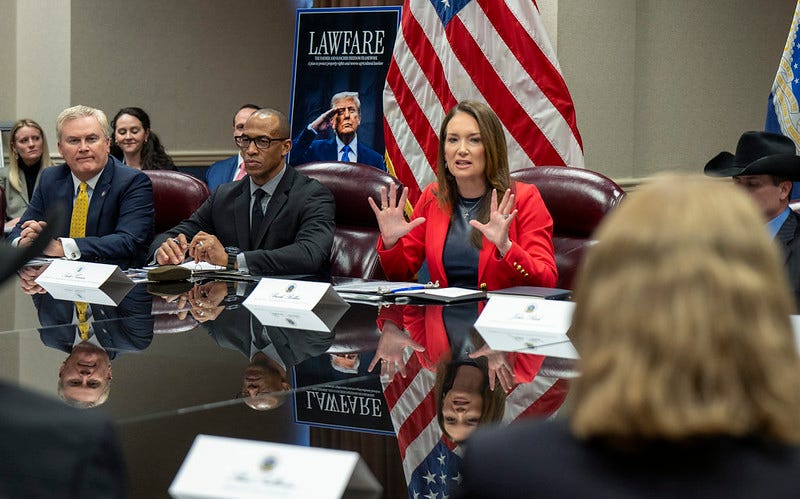
Ranchers gather in D.C. as USDA goes on offense against agricultural lawfare
Secretary Rollins is positioning the USDA as a defender of small American farmers and ranchers.

Ranchers who say they have been targeted by government agencies gathered Wednesday in the nation’s capital to stand with Agriculture Secretary Brooke Rollins as she announced new efforts to combat agricultural lawfare.
Charles and Heather Maude of South Dakota, Wade and Teresa King of Washington, Shad Sullivan of R-CALF USA, and Rich Brazil of Northern California were among those present. Each represent a case of agricultural lawfare—the use of administrative, legal, or legislative government systems to pressure or penalize producers or rural communities. Many of these stories were broken by UNWON.
The Farmer and Rancher Freedom Framework is Rollins’ answer to what she sees as systemic abuses against producers. The initiative outlines four pillars and accompanying action items, formalizing efforts Rollins has taken at the U.S. Department of Agriculture (USDA) to address overreach.


A new direction at USDA
“We are restoring power to producers and renewing America’s promise to protect private property rights and American agriculture,” Rollins said in her opening remarks. “These are not just economic principles. They are the very cornerstone of the American dream, woven into the very fabric of our nation. As we approach the 250th anniversary of our incredible country, we are reminded that this nation was founded by a republic of farmers.”
Since her appointment by President Trump last year, Rollins has repeatedly dedicated the angency’s efforts and her own platform to address obscure cases of lawfare against family farmers and rural communities. It’s a focus that has come to define her leadership.
Rollins’ first press conference as USDA secretary was centered on the Maudes’ case. Charles and Heather Maude each faced 10 years in prison and $250,000 in fines over a minor fence dispute. Rollins announced charges had been dropped. She also introduced an online portal for other victims to report similar abuses.
The initiative against lawfare marks a shift at the USDA. Rollins has continued to position the USDA as an active defender of producers in legal and bureaucratic battles. For ranchers who say they have long felt ignored or attacked by federal agencies, Wednesday’s event marked a rare moment of public alignment with the nation’s top agriculture official.
Ranchers share stories of government overreach
Rollins’ framework points out that every day, the U.S. loses 5,000 acres of working lands. From prison threats to fines to canceled grazing leases to demolished water infrastructure, the stories shared by ranchers at the launch event painted an alarming picture of how overzealous regulators and hostile officials contribute to the loss of farmland and threaten the future of independent agriculture.
Heather Maude spoke about her family’s persecution at the hands of Forest Service agents, and said she feared more was coming.
“We believe this could not be more timely,” she said. “The odds state that we will face additional lawfare now that we are under an agency’s target. But we are very thankful for the acknowledgement that that is the case and for this change, and we look forward to working with this administration to ensure that we never face this again.”
Andy Henry’s case was also resolved thanks to Rollins’ advocacy. The Henry family’s 175 year-old farm was threatened with eminent domain by their local township in an effort to convert the property to affordable housing.
“I just want to say, Secretary Rollins, your phone call to me last June meant a lot,” said Henry. “I began to feel we might just prevail in this case. And I hope this publicity will cause some to think twice before taking a farm.”
Rich Brazil represented rural water users in Northern California who rely on the Potter Valley Project, a 100 year-old dam system that supplies over 600,000 people with water. The dams are slated for removal by Pacific Gas & Electric (PG&E), a state-regulated energy company.
“This is an issue about weaponization of government against its people,” Brazil said. “It’s about abuse of power, it’s about the corruption of our very institutions. It’s about abuse of the legal system—‘lawfare.’ It’s about abuse of science—‘sciencefare.’ It’s about the abuse and corruption of our processes, about quid pro quos, and it’s ultimately about a fundamental disregard for ‘we the people.’”
Another unresolved case represented at the table: Wade and Teresa King were fined and their grazing leases removed for alleged disturbance to “alkali wetlands.” The Kings say they are manmade stock watering ponds.
“To be clear, we have done nothing wrong that hasn’t been done on our property and all across the Western United States for generations as far as cleaning our stock ponds,” Wade King said. “Thousands and thousands of ranchers are in the same situation and the Department of Ecology and the state of Washington is trying to use us as a precedent-setting case.”

Support from Capitol Hill
A number of officials attended the rollout including Rep. James Comer (R-Kentucky), head of the House Oversight Committee; Scott Turner, secretary of the Department of Housing & Urban Development; and Aubrey Bettencourt, chief of the Natural Resources Conservation Service (NRCS). Country singer John Rich was also present as an advocate for rural issues.
“My job is going to be to shine massive spotlights on any agency, any state government, any private company that is stepping on the constitutional rights of American citizens,” Rich said.

Whether the initiative will result in concrete regulatory changes is unclear. For the ranchers gathered in Washington, the announcement signaled that their cases are no longer isolated disputes, but part of a broader political and legal battle over the future of American agriculture.