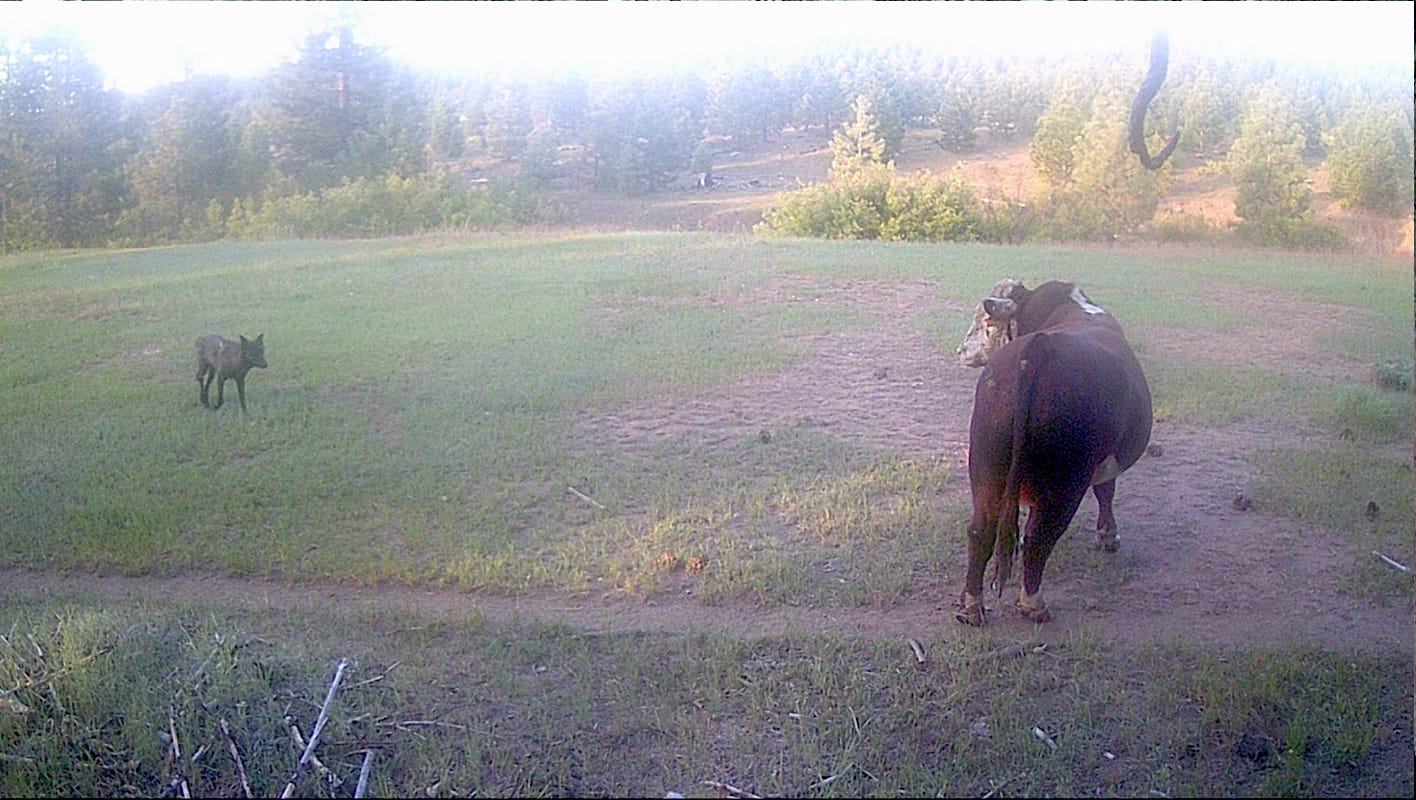
Study finds beef is the main food source for California wolves
Researchers from U.C. Davis say wolves in California are living on domesticated cattle herds, and cattle are stressed in regions wolves are present.

Ranchers in California’s rural north say wolves pose an existential threat to their cattle. New research from U.C. Davis backs them up: Cattle made up the majority of wolves’ diets in Northern California in 2022 and 2023.
For those two summers, scientists collected wolf scat samples in Lassen and Plumas Counties. They found that on average, 72% of those samples contained beef. Mule deer, wolves’ usual prey, appeared in just 45%. Of the 20 individual wolves identified in the study, 17 had consumed cattle. The three that hadn’t were each represented by a single sample.
Lead author Tina Saitone concluded wolf populations are exploding in California because of livestock. They are living on cattle.
“Essentially, the cattle industry in California is really supporting the conservation success of wolves,” she said in an interview with The Sacramento Bee. “There are multiple problems that are creating a situation where wolves are highly dependent on cattle to save themselves.”
Beef accounted for more than half of the biomass in the wolves’ summer diet. It was 88% of wolves’ two main ungulate diet items in 2022 and 78% in 2023. By contrast, mule deer—wolves’ usual prey—contributed just 12%.
And that number is conservative. Researchers calculated it using the weight of a calf. Wolves in the study area were confirmed to have killed full-grown cattle as well; at that weight, cattle would account for more than 80% of what the wolves ate.
A second U.C. Davis study found wolves are harming California cattle herds by their presence alone. Published in Ecology and Evolution, the study measured cortisol levels in tail hair from cattle in Northern California. It found that herds living among wolves had 58% higher cortisol levels than their counterparts. Stress damages pregnancy and wean rates in cattle, hurting ranch income in ways the state's compensation program, which pays only for confirmed or probable kills, doesn't cover.
“Beyond direct predation, wolves impose additional costs,” Saitone said. “Cattle exposed to wolves show increased vigilance and avoidance behaviors that reduce weight gain and conception rates while increasing disease vulnerability. Producers face higher expenses from intensified monitoring, fence repairs, non-lethal deterrents, and depredation investigations.”
In California, gray wolves are protected by both state and federal law. It’s illegal to shoot at wolves to protect livestock or pets.
Ranchers cope with predator overload
The new data is especially concerning given ranchers say the threat has only escalated in the two years since the samples were collected.
“It's so awful because these are the animals that we are here to protect,” said Theodora Johnson, a Siskiyou County rancher, in UNWON’s 2025 story on wolf predation. “We're in charge of them, we care for them, they rely on us for their care, and we're allowing this to happen. And you can't do anything about it."
California is an extreme outlier. A North American review found domesticated animals made up about 8% of wolf diet. While ranchers in other states are also impacted by expanding wolf predation, in California it’s a true crisis. California's wolves are eating cattle at eight to nine times the national rate.
Patrick Griffin, Siskiyou County wolf liaison, has inspected 80 wolf kills in the decade wolves have been in Northern California.
“We’re seeing more depredations as a result of wolf kills than bears and mountain lions put together,” he said.
The “Beyem Seyo” pack in Sierra Valley killed or injured almost 100 cattle in a seven-month period in 2025, costing ranchers between $534,000 and $1.7 million in livestock depredations and the state at least $2 million in intervention costs. California Department of Fish & Wildlife (CDFW) deployed a “Summer Strike Team” for non-lethal hazing. 114 days and over 18,000 staff hours later, attacks kept rising. State wildlife officials eventually euthanized four wolves in the pack.
Some believe wolves are preying on cattle because there’s almost nothing else to eat. Mule deer populations have collapsed in this part of California due to severe wildlife mismanagement and failure to control increasing numbers of predators. Mule deer numbers fell from roughly 950,000 in northeastern California in 1990 to about 250,000 by the mid-1990s.
1990 was the year California banned mountain lion hunting. More recently, the state limited black bear hunts as well.
“If we’re going to have wolves, we have to manage the wild prey more successfully than we are,” Griffin said. “California tends to manage for revenue rather than benefit of wildlife. That needs to change.”
READ MORE:
Thrown to the wolves: California ranchers under siege
Last year, the state of California ran out of money to reimburse ranchers for livestock killed by wolves.