

The Eel-Russian Project Authority (ERPA) has responded to an UNWON article that reported information from a Round Valley Indian Tribes meeting involving Potter Valley dam removal. ERPA has accused UNWON of “misinformation” and “inaccuracies” in reporting.
ERPA is a joint powers authority. Signatories include Round Valley Indian Tribes (RVIT), County of Sonoma, Mendocino County Inland Water & Power Commission (IWPC), and Sonoma County Water Agency.


According to ERPA:
UNWON published statements without the full context of a presentation given to the Round Valley Indian Tribes and relied on selected excerpts that resulted in misinformation. This response corrects the blog post’s inaccuracies and offers clarifying information.
Having been accused of presenting comments out of context, the following video clips show attorney Curtis Berkey’s statements in full, as recorded during the publicly streamed November 22 RVIT meeting.
If ERPA is accusing Berkey of misrepresenting the Two-Basin Solution to RVIT members at the meeting, they should explicitly state that.
Note: The November 22 RVIT meeting was recorded and streamed publicly by an attendee on a Facebook profile, where it remained publicly accessible as of publication. Quotes are transcribed as accurately as possible; minor discrepancies may exist due to audio quality.
Responding to accusations of “misinformation” and missing context
Quote from ERPA:
UNWON Claim: “Diversions must stop if salmon decline for any reason … Round Valley can end diversions every five years.”
This is not what the Water Diversion Agreement says. There is no automatic termination of Eel River diversions through the New Eel-Russian Facility tied to decline of salmon in the Eel River, nor does the agreement give Round Valley Indian Tribes unilateral authority to terminate diversions. Rather, the five-year review cycle is a standard science-based assessment of habitat conditions, water quality, and fish passage to determine whether water diversion operations are performing as expected. If concerns arise, the remedy is adaptive management and potential adjustment to diversion timing through a shared, multi-party process that includes state and federal agencies. Dispute resolution is structured and collaborative, and performance reviews do not nullify the investment or halt operations. The purpose of the framework is to protect fisheries while maintaining a reliable, long-term diversion.
Curtis Berkey, attorney for RVIT:
“If we conclude, we show, that the evidence shows that fish are continuing to decline and not recovering, then those diversions have to stop. OK? So that’s the key or we have to talk about that, what are we gonna do about that. So yes there will be, under this agreement, there will be, diversions will continue, but subject to strict control, and a check-in every five years during this initial period.”
Clip from the publicly streamed November 22 Round Valley Indian Tribes membership meeting, posted by an attendee on Facebook.
Quote from ERPA:
UNWON Claim: “No dams, no water. Diversions will stop.”
The Two-Basin Solution does not stop diversions; it provides a contractually binding way for them to continue, preventing the complete loss of the diversion.
Curtis Berkey, attorney for RVIT:
“There will come a time, when, no matter what happens, the diversions will stop. And you can say, ‘We’re not going to renew this agreement. That’s the end of it.’ So that will happen for sure.”
Clip from the publicly streamed meeting, posted by an attendee on Facebook.
Quote from ERPA:
UNWON Claim: “Communities will not receive summer water at all … Diversions only in winter, and only in good rain years.”
The shift to seasonal diversion is intended to prevent harm to fisheries, but it does not eliminate summer water. Diversions are not limited to winter under the Water Diversion Agreement; instead, the agreement’s diversion criteria ensure diversions occur when flows are sufficient for fish passage. Extensive modeling shows average annual diversion volumes sent to storage of about 30,000 acre-feet with water available for diversion in most year types. With the construction of additional storage infrastructure, greater volumes of Eel River water could be successfully stored, allowing storage beyond 30,000 acre-feet per year on average.
Curtis Berkey, attorney for RVIT:
“…the key thing for us, for Round Valley Tribes and others concerned about Eel River fisheries is, during the summer months when the river is at its lowest flow and you need to keep water in the river so that it doesn’t get too hot for salmon in the river, no diversions can occur. The diversions are only going to happen in the wintertime when the flows are really high and even if they’re not high enough in the wintertime no flows can occur.”
Clip from the publicly streamed meeting, posted by an attendee on Facebook.
Quote from ERPA:
UNWON Claim: “Counties must raise $25 million or diversions stop in 30 years.”
Fact: The $25 million fundraising target is part of a broader Eel River restoration commitment made by all the parties to the Water Diversion Agreement collectively, not just the counties. The first $9 million of the $25 million goal has already been committed. If the target is not fully met, the Water Diversion Agreement allows the parties to adjust terms or negotiate extensions, it does not end diversions after 30 years.
Curtis Berkey, RVIT attorney:
“If they don’t raise that money, you know, the diversions stop in 30 years. Period, the end. That’s an absolute condition.”
Clip from the publicly streamed membership meeting, posted by an attendee on Facebook.
For additional context, relevant quotes from Berkey’s slide presentation:
“Water diversions may only occur so long as they do not harm fish or hinder recovery.”
“No diversions unless assurances of no harm to the fish and no interference with recovery for 30 years, 20-year renewal on strict conditions, end at year 50”
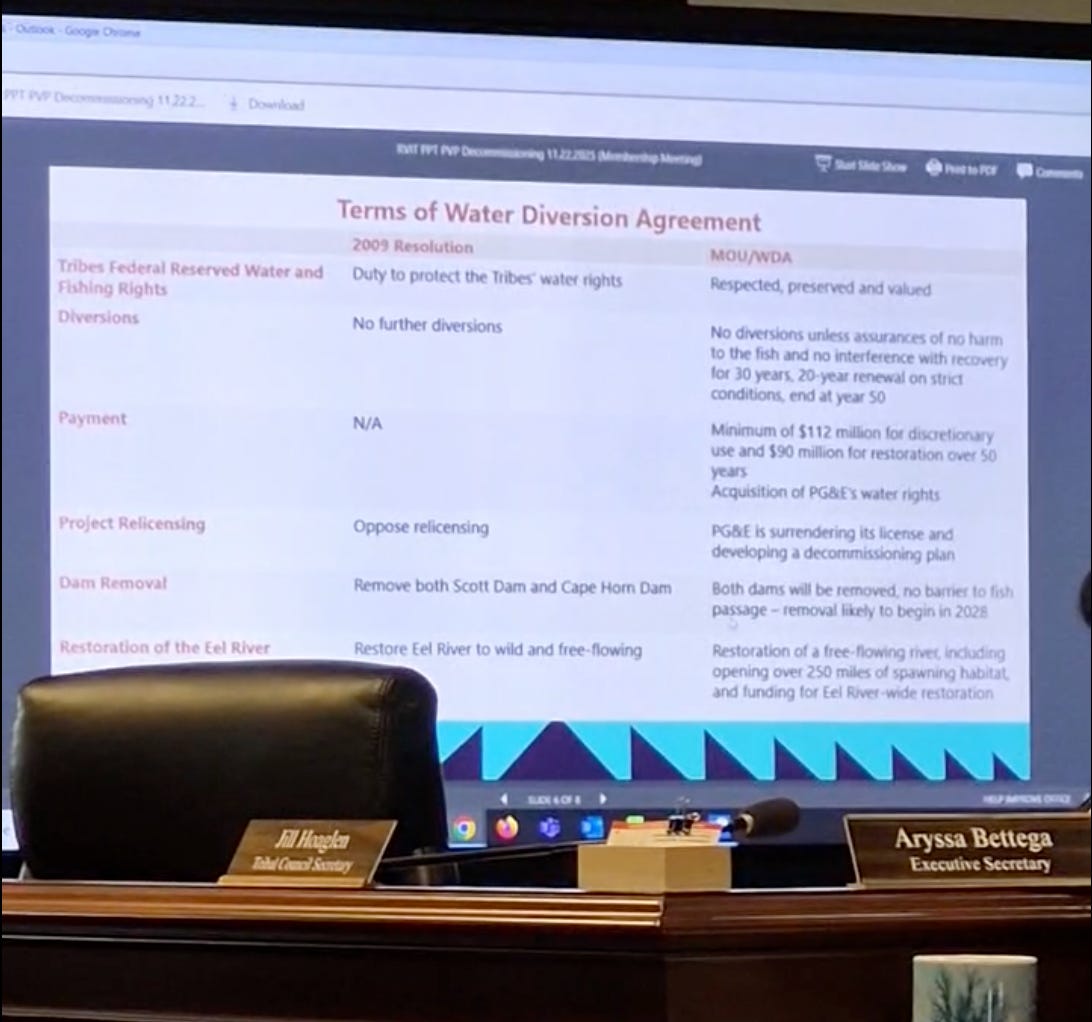
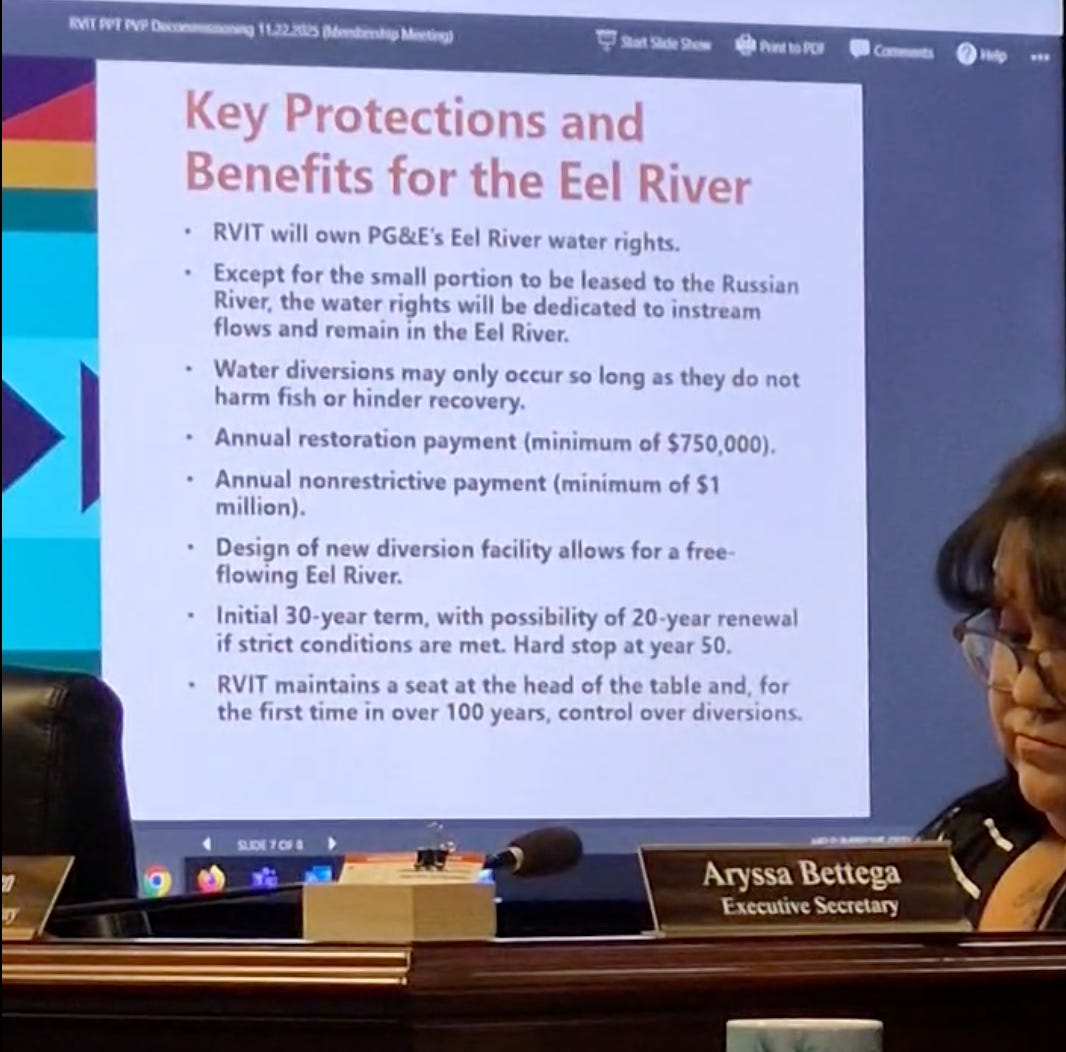
Screenshots from the publicly streamed membership meeting, posted by an attendee on Facebook.
Responding to rebuttals of opinions
Quote from ERPA:
UNWON Claim: “The Two-Basin Solution is checkmate. The end of Potter Valley.”
The Two-Basin Solution, as implemented through the Water Diversion Agreement, specifically provides for continued diversions into the Russian River and the work that Mendocino County Inland Water and Power Commission is doing will bring additional storage online to benefit Potter Valley and the greater Russian River watershed.
UNWON article (Potter Valley rancher opinion):
“This is what we’re locking ourselves into with this agreement,” says a Potter Valley rancher who asked to remain anonymous. “Why would the feds or anyone else give hundreds of millions of dollars to develop future water storage—raise dams, put in reservoirs—under this agreement? This Two-Basin Solution is checkmate. The end of Potter Valley and beyond.”
This is an opinion expressed by a rancher. ERPA & co. are welcome to express their opinions, as is the public.
Quote from ERPA:
UNWON Claim: “Round Valley lacks connection to the Upper Eel basin.”
The proximity of the Round Valley Indian Tribes’ Reservation lands to Scott Dam is not a relevant factor. Round Valley Indian Tribes have a time immemorial presence in the Eel River basin and have relied on the Eel River and its fishery for subsistence, cultural, recreational and economic purposes since time began.
UNWON article (Potter Valley rancher opinion):
Another Potter Valley rancher points out that while Round Valley has an interest in the Middle and North Forks of the Eel River, it is “completely disconnected” from the Upper Eel, where dams are located.
“And it only minimally touches on the Main Branch of the Eel, into which the Upper Eel drains,” he adds. “It has much less involvement in the Upper Eel than a number of other tribes.”
The Potter Valley Tribe recently filed a motion to intervene in dam removal, saying they have been kept out of the conversation entirely. Lake County, where Lake Pillsbury is located, is home to seven federally-recognized tribes and has also been shut out of stakeholder discussions.
This is an opinion expressed by a rancher. ERPA & co. are welcome to express their opinions, as is the public.
Quote from ERPA:
UNWON Claim: “The Two-Basin Solution ends Potter Valley agriculture.”
The Two-Basin Solution is the only way irrigated agriculture will survive in Potter Valley. Technical analysis shows that with the New Eel-Russian Facility and the water available because of the Water Diversion Agreement, plus additional local storage, conjunctive groundwater use, efficiency projects and system improvements, Potter Valley agriculture will remain viable
This quote is not in the UNWON article.
Editor’s Note:
ERPA and the other signatories on this rebuttal document represent the needs and interests of the public. In my view, attempts to smear grassroots journalistic efforts to bring sunlight and transparency to a high-stakes issue involving the future of water for over 600,000 citizens—including hundreds of farms and ranches—as “misinformation,” reflects poorly on those bodies. The public has a right to this information.
That they felt a need to respond should validate the fact that you are, as they say, hitting close to the target.
Anyone who thinks this attorney for the RV Nation has the Nation’s best interests at heart needs to have a sanity check. He is paid thug, why this writer can’t figure out is why the RV nation is taking his blankets filled with smallpox. In the end 5-10-15-20 years from now the RV will have no comtrol over the watershed and they will be broke as broke can be, further they will be isolated and reviled for this insult to 600,000 local population. This movie is in editing rework because we have seen it so many times. Keep the fight going and look for every bad actor to show up and support dam removal. Just fight them until they relent.