


Between the San Francisco Bay Area and the dark timber country of the Pacific Northwest, for a moment California’s coastline hits nirvana. The road cuts between ancient redwoods, through hills drenched in fog, and opens into valleys brief and brilliant, divided into green pastures and vineyards and wineries and ranches.
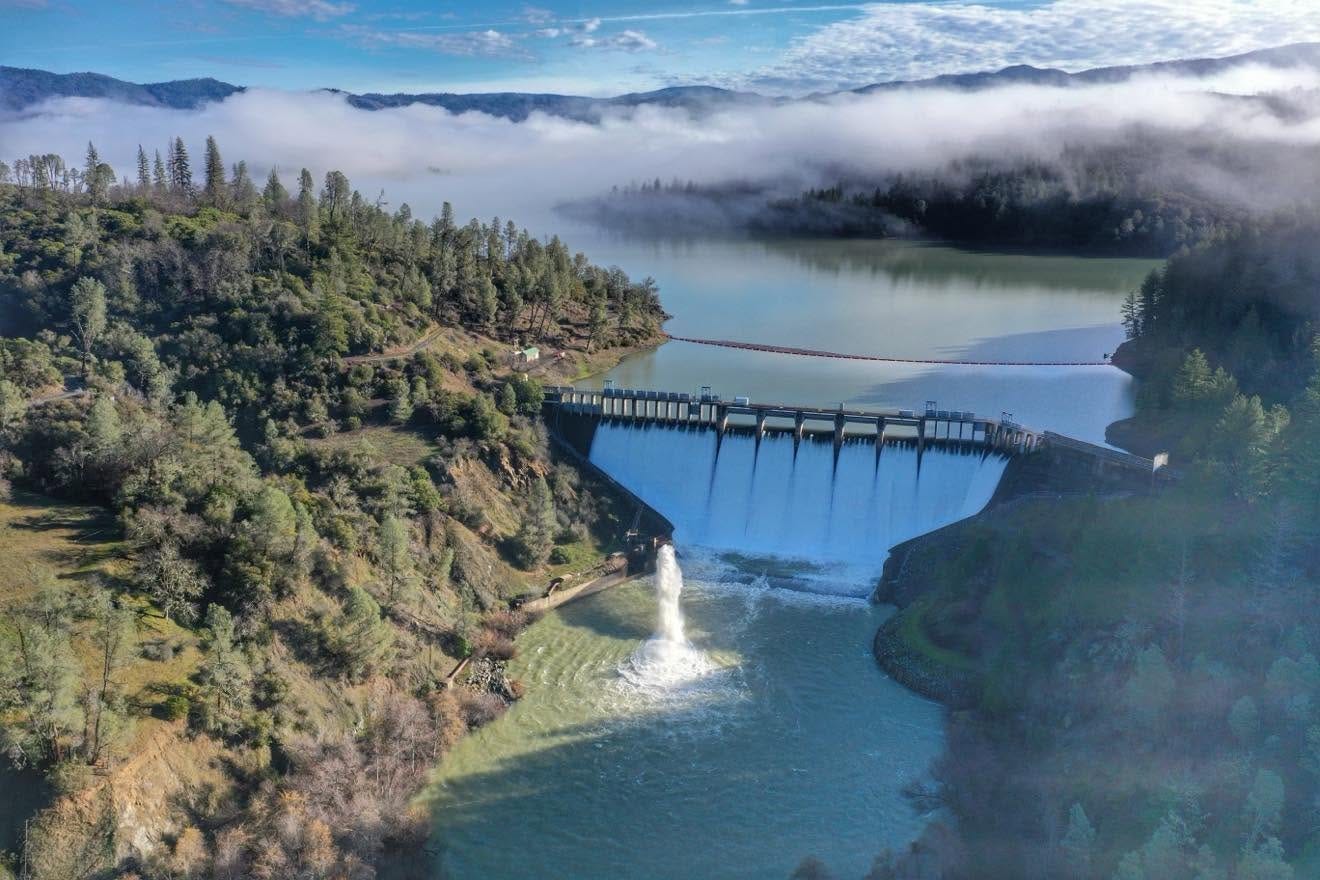
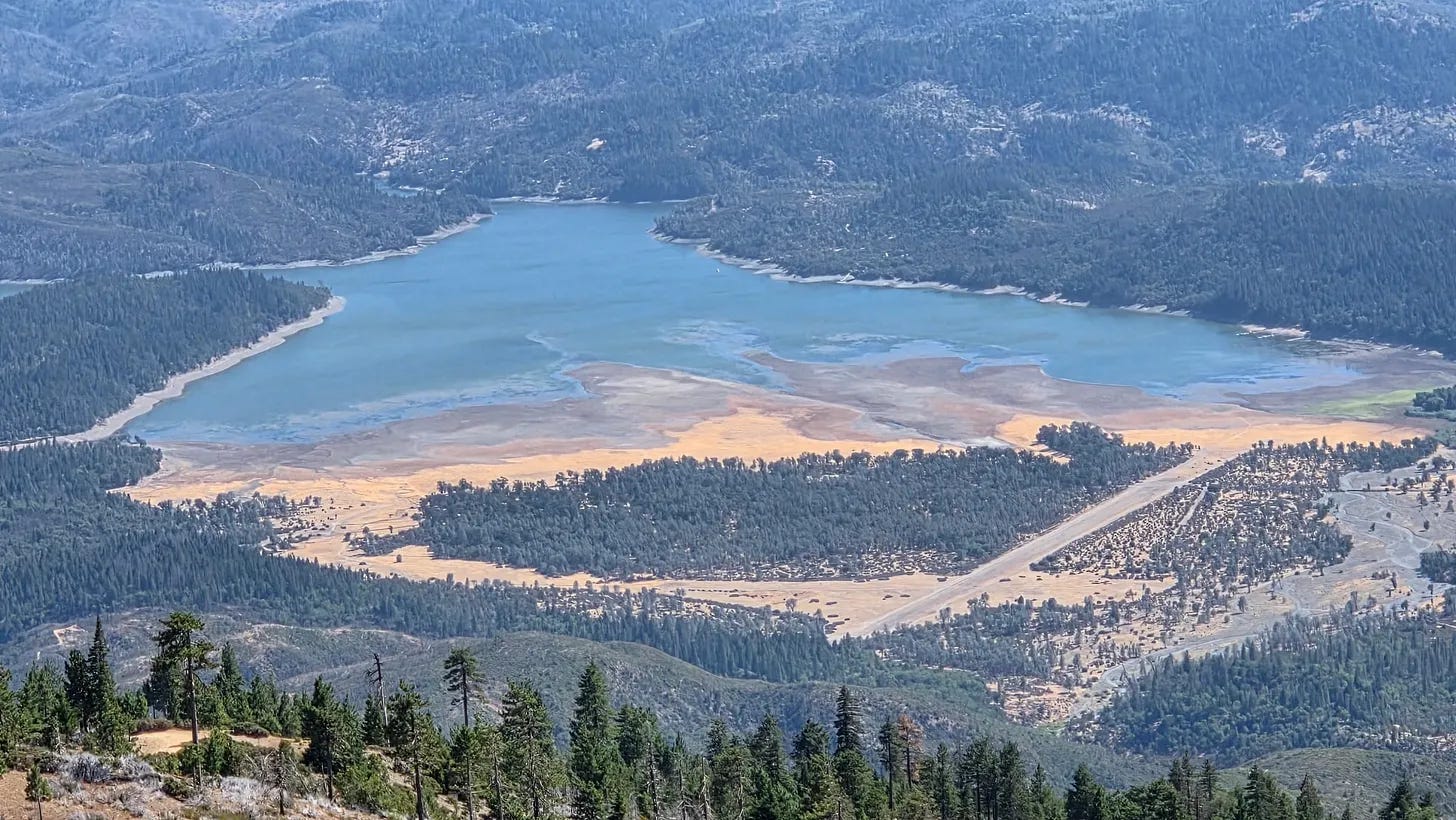
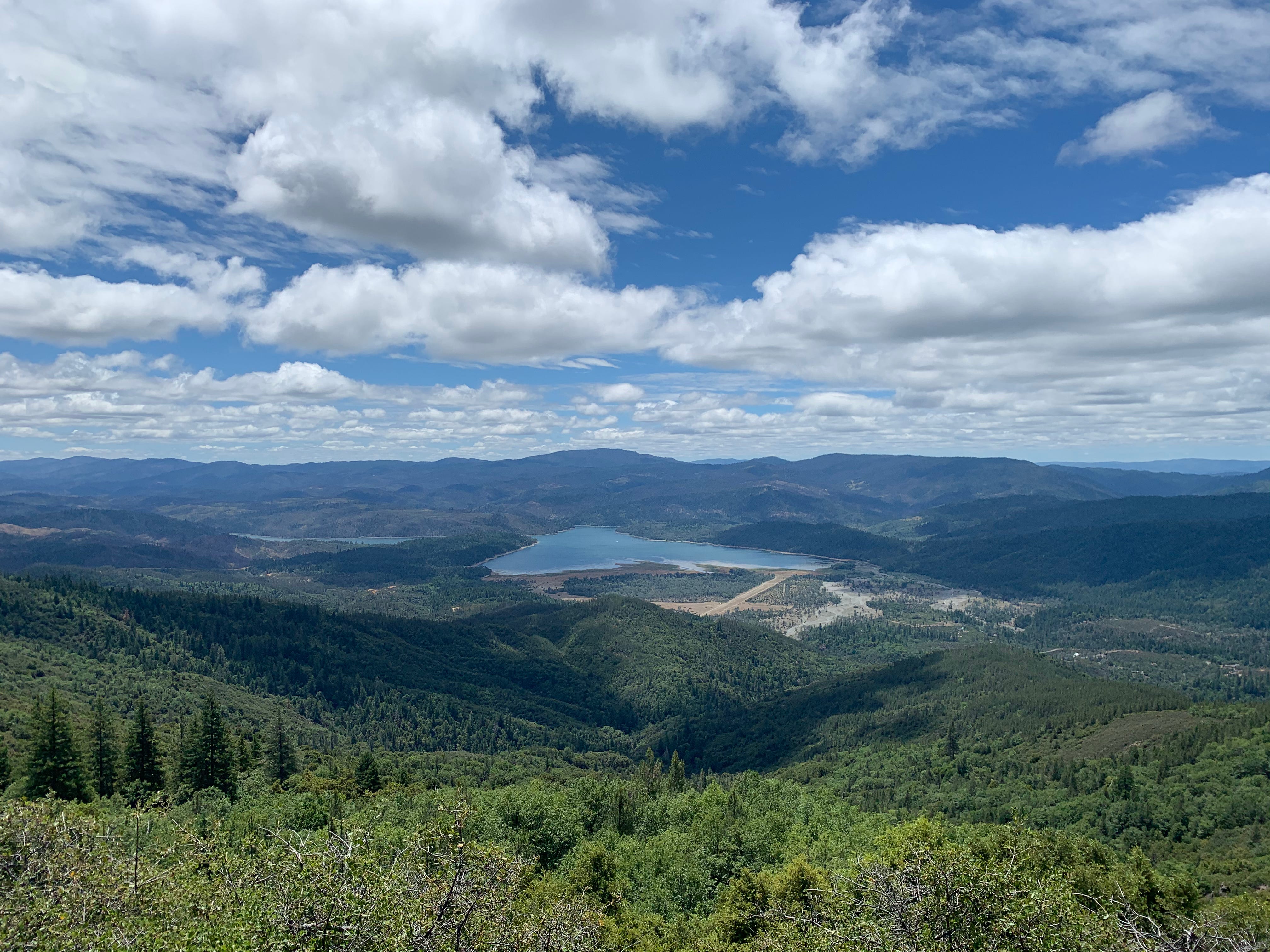
Rain only falls in the winter here; the summers are hot and dry. From Potter Valley in Mendocino County to Bodega Bay in Sonoma, the region gets much of its water because of a man-made lake deep in the mountains of the Mendocino National Forest. That lake may soon be gone, dried up by a shift in political winds. The water, and the region, will be gone with it.
The fate of Lake Pillsbury
Lake Pillsbury created the Redwood Empire. Without it, the famous vineyards of Sonoma would not exist, and the pear orchards and hay fields and cattle ranches of Mendocino County would shrink or disappear. Yet most in its wealthiest zip codes have never heard of it, nor of the handful of enterprising men who, over 100 years ago, thought up a hydroelectric project that would create power by holding back a small portion of water from the mighty Eel River during its roaring wet winters, in Lake Pillsbury deep in the Coast Ranges. From there the water goes on to the towns and valleys of the Russian River watershed—water that would otherwise be lost at sea with the rest of the winter rush, and there would be no water in the summer when it’s needed most.

I grew up in Potter Valley, a rodeo town best known for being the last sign of civilization before the hour-long climb over washboarded roads to Lake Pillsbury.
This was my backyard. I knew the secret of the North State’s water because Potter Valley and its mountains held all my childhood.
In a future where there is no more Heaven on the Northern California coast, where the childhoods we cherished cannot be handed down to our children, where all that’s left are photographs, this may be the only account of what happened.
Future reader: Here’s how it came to be.

The Redwood Empire was created by a secret mountain lake
Before the Potter Valley Project was built, every summer the Eel River and the Russian River ran dry, and during many winters they flooded their banks.
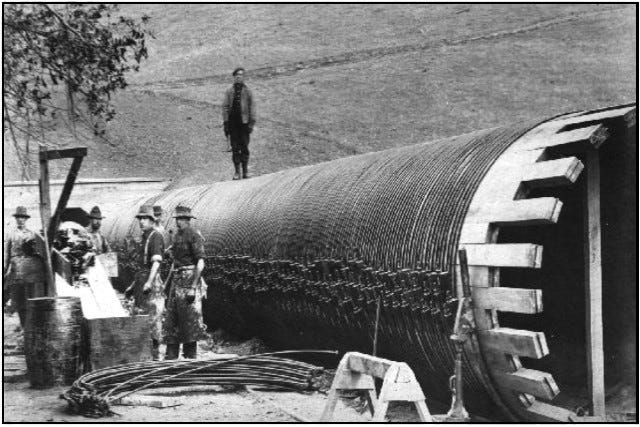
Then the Snow Mountain Water & Power Company built two dams on the Eel River to hold back some of its winter excess from draining into the sea. Those forgotten men who made this region what it is did so almost by accident; they built little Cape Horn Dam to create a reservoir, then drilled a mile-long tunnel through the mountain to harness that water for their hydropower plant. When they saw it wouldn’t provide year-round water, they built Scott Dam even deeper in the mountains, which made Lake Pillsbury. That was the Potter Valley hydroelectric project; so named for our valley, where the water made its first stop.
The Potter Valley Project began producing power in 1908, was completed with Scott Dam in 1922, and was purchased by Pacific Gas & Electric (PG&E) in 1930. The dams provided some flood control during winter and early spring, and a steady water supply in the summer and early fall.
Today, it supplies water to 750,000 people and hundreds of farms and ranches.
In July 2025, PG&E filed a formal license-surrender application and decommissioning plan with federal regulators at the Federal Energy Regulatory Commission, the governing body that controls dam licensing. FERC accepted the application on October 31, 2025, and opened a public comment period. If approved, it will be one of the largest dam removal endeavors in history.
How the dams were doomed
For decades, PG&E produced power and made a profit with the Potter Valley Project. Then the environmental groups began suing, claiming the dams blocked salmon and steelhead habitat. In 2002, the National Marine Fisheries Service issued a new Biological Opinion declaring the dam, and diversions from the Eel River, were partly to blame for declining fish populations, along with factors like logging, commercial fishing, and two devastating floods in 1955 and 1964.
In 2004, the government slashed the amount of water PG&E could divert from the Eel River by over half. This cut into PG&E’s power production, strangling the Potter Valley Project’s profitability.
Meanwhile, political tides were turning in the state. California had become a Democrat stronghold, and an ambitious young governor had his eyes on national office. In order to advance, he needed the favor of the state’s powerful green lobby. By removing the river system’s only dams, the Eel River could be called California’s longest free-flowing river, and that was a tempting talking point.
Dam removal will not restore fish populations
If diversions from the dams were harming fish, as the environmental lawsuits alleged and the Biological Opinion assumed, then salmon and steelhead numbers should have begun to recover in the 22 years since diversions from the Eel River have been cut—ultimately by 80%. But that has not happened. In fact, salmon counts were twice as high in 1990-2004 as in 2019-2024. Steelhead counts were four times higher. Both species remain listed as threatened.
PG&E has long held that the dams help fish. In August 2022, as CalTrout, Friends of the Eel River, Trout Unlimited, and other NGOs prepared to sue again, a spokesman for PG&E told The Mendocino Voice: “PG&E believes its operations benefit salmonids by storing and providing water that otherwise would not be available for release, particularly during dry seasons.”
PG&E repeated the point to federal regulators. In a February 2025 filing with FERC, the company said “it is necessary to conserve water in Lake Pillsbury and provide adequate flow releases,” and that stored “cooler water will be released in late summer in support of federally ESA-listed species.”
The same NGOs pushing to kill the dams agreed. In a June 2024 letter to FERC, CalTrout, Trout Unlimited, Friends of the Eel River, and eight other groups urged regulators to protect “a pool of cool water in the Lake Pillsbury Reservoir,” writing that “effective management of cold-water resources is crucial for the survival of these species.”
This letter did not acknowledge a glaring incongruity: Their simultaneous efforts to remove the dams would permanently cut off these “crucial” flows.
What really happened to the salmon?
I have always preferred the wisdom of locals to the opinions of Bay Area activists and weekend fly fishermen. The old timers and Indian elders of Mendocino County tell me the best salmon runs happened well after the dams were built. They blame logging roads and Chinese overfishing in the Pacific and massive depredation by predators at the mouth of the river and the toxic runoff from illegal cannabis cultivation endemic to this region for killing off the salmon and steelhead, not the dams.
It started as far back as the late 1800s, when commercial fishing supplied millions of pounds of salmon to canneries in Humboldt County.
“They fished until there wasn’t a fish left to catch and the canneries had to close,” said Steven Elliott, who served as Superintendent of the Potter Valley Irrigation District from 1989 until his recent retirement.
Early logging left immense timber slash in the creek drainages, and stream crossings built on thousands of miles of roads blocked fish migration from one end of the Eel to the other. In 1955 and again in December 1964, floods scoured every stream in the drainage clear to Fernbridge.
“Whole mountain sides were lost,” Elliott said. “I saw it happen, and I believe the spawning grounds are still repairing themselves today.”
In the 1960s, the fish ladder at Cape Horn Dam was operated as an egg-harvesting station. Millions of eggs were shipped to hatcheries across the country and as far abroad as New Zealand.
Then in the 1980s, the pikeminnow arrived. This fish feeds on salmon fry, and is now well-established in the Eel River. Officials have blamed fishermen for introducing pikeminnow, but Elliott says it was the state. His predecessors watched Fish and Game personnel plant the invasive predator in Lake Pillsbury, intending it as a sport fish.
Local advocates say much can and should be done to restore salmon and steelhead numbers, including getting pikeminnow under control, eradicating river pollution, and restoring tributaries.
Scott Dam, without a fish ladder, blocks “a minuscule portion of the thousands of miles of actual spawning habitat available in the Eel River drainage,” Elliott said. “Surveys are now showing less than 50 miles, not hundreds as claimed.”
Fish still spawn in the tributaries just below the dam—Soda Creek, Welch Creek, Panther Creek. Officials could reopen tributary access cut off by the abandoned Northwestern Pacific Railroad line, which runs more than 100 miles along the Eel. This lost habitat dwarfs what’s lost above Lake Pillsbury.
“What if we spent the hundreds of millions of dollars it will take to destroy Lake Pillsbury storage,” Elliott said, “instead on habitat restoration where fish can no longer access their spawning grounds downstream of the dam, such as the Middle Fork?”
There’s another proven option to the fish passage issue. Cape Horn Dam has had a fish ladder since the early 1900s. Scott Dam does not have a ladder. On Oregon’s Clackamas River, the 206-foot North Fork Dam pairs a nearly two-mile fish ladder with a floating collector that pipes young fish past three dams. In 2021, early-run coho returns there hit their highest count since 1958. On Washington’s Baker River, where sockeye fell to 99 fish in 1985, a trap-and-truck system collected a record 65,512 in 2023.
In 2018, Sonoma Water hired an engineering firm to study fish passage at the Potter Valley Project. The final report priced upgrading the Cape Horn Dam fish ladder and screen at about $2.6 million each, and $26 million for a ladder at Scott Dam.
The true beneficiary of dam removal: Gavin Newsom
The Eel receives about 8,077,000 acre feet of water each year. The Potter Valley Project diverts less than one half of one percent of it—0.37%—for human use. Everything else runs to the Pacific.
But the optics were what mattered, not the fish, not the farmers, not the water, not reality.
And the optics of a free flowing river—and all those millions of government dollars sure to be earmarked for its “restoration” and shoveled to NGO after NGO—was the sort of thing that would make the environmental lobby—powerful, deep-pocketed, and omnipotent in California politics—look favorably on a young upstart politician like Newsom.
The farms and ranches and tribes and communities of places like Potter Valley and Lake County were small sacrifices to the cause of such ambition.
PG&E infrastructure sparks deadly wildfires, plunging it into bankruptcy
As a state-regulated utility monopoly, PG&E is controlled by the California Public Utilities Commission (CPUC), whose members are appointed by the governor. PG&E’s viability depends on the decisions of the governor; it is only profitable at his pleasure.
Not coincidentally, PG&E is a major political donor in California. An ABC10 investigation found that, of the state’s 55 members of Congress, 44 had taken PG&E money.
In 2017, PG&E’s license for the Potter Valley Project was coming up for renewal, and they planned to renew. They had no intention of giving up the Potter Valley Project. It would be corporate suicide to surrender a viable hydroelectric project with water rights attached in California of all places, where water and energy are rendered especially precious because leaders forgot how to build anything and citizens must rely on relics for survival.
In April 2017, PG&E filed a Notice of Intent with FERC to continue operating the dams. They invested in improving the Diversion Tunnel, replacing all of its penstock and upgrading the needle valve.
A few months later, in October 2017, PG&E equipment sparked the Redwood Complex Fire in Potter Valley.
“I’m a lineman for PG&E and was at that powerhouse working on generating power for Potter Valley when the fire department came into the powerhouse and said, leave everything that’s out, grab your workers and vehicles and leave now,” said Curtis Grimes in a Facebook comment. “I was shocked to see the powerhouse still standing the next day.”
The Potter Valley Volunteer Fire Department worked through the night to save the powerhouse, built with old redwood timber.
The CEO of PG&E visited the little Potter Valley Fire Station on Main Street, a $25,000 check in hand, to thank the humble group of volunteer firemen for their service. The marketing team at PG&E brought a film crew, and published a video.
“It would have been devastating to the valley,” Mike Evans, a roving operator for PG&E, tells the camera. “There could have been, you know, millions of dollars of crops lost, the drinking water’s gone. Fortunately with our local Potter Valley Fire Department, they’re all volunteers, they have an interest in the valley, they know the importance of this water.”
PG&E pleads guilty to 84 counts of manslaughter
If you don’t live in California but the name PG&E sounds familiar, perhaps you have watched Erin Brockovich recently. Or The Last Bus. PG&E has had more than its share of corporate scandals. It became the first major utility in U.S. history to be convicted of homicide after pleading guilty to 84 counts of manslaughter in the Camp Fire.
This infamous fire in Paradise, California was sparked by faulty PG&E equipment on November 8, 2018, just two days after Gavin Newsom was elected governor.
Survivors sued. PG&E prepared for bankruptcy.
Then the new governor threw them a lifeline.


Quid pro quo between Newsom & PG&E?
Newsom told the San Francisco Chronicle in January 2019 that he had been in communication with PG&E executives during his gubernatorial transition. He said he had their cell phone numbers and could have “very honest conversations.”
Early on, he showed a willingness to back PG&E bailout bill AB 1054. This legislation formed a $21 billion wildfire insurance fund, half financed by PG&E customers, half by its shareholders. California citizens would foot the cost for PG&E’s bloody negligence.
In January 2019, shortly after Newsom’s inauguration, PG&E withdrew its intent to relicense the Potter Valley Project. Four days later, they filed for Chapter 11 bankruptcy.
The beleaguered company had already begun to explore divesting from the dams, and had opened an auction for them in September 2018. But strangely, it ended the auction the day it withdrew its application to renew the license.
In February, Newsom's office signed a $9.6 million contract with O'Melveny & Myers, PG&E's longtime firm, to write the PG&E bailout bill.
Then there was the meeting in June, verified by calendar records attorney Mike Aguirre obtained in his lawsuit challenging AB 1054. Six PG&E reps met with Newsom staffers and O'Melveny's lead attorney. The lawyers who wrote AB 1054 worked for a firm that had previously represented PG&E, a stunning conflict in itself.
Also in the room: a Newsom staffer named Alice Reynolds. By 2021, she would be running the CPUC.
Sources say all attendees were required to sign NDAs. It is alleged that AB 1054 was on the docket that day. So, according to several sources, though I cannot verify this is true, was the Potter Valley Project.
We do know that PG&E moved forward with plans to decommission the Potter Valley Project.
And we know that in July 2019, Governor Newsom signed AB 1054 into law, and bailed PG&E out.
Dirty history with PG&E
At that time, PG&E had deep financial ties to the Newsom family. PG&E had given at least $227,000 to Newsom’s various political campaigns and committees—plus $10,000 to a charity led by his sister, and $358,000 to a gender non-profit founded by his wife, Jennifer Siebel Newsom. PG&E was listed as an associate producer in the credits of two of Siebel Newsom’s documentary films.
Even Newsom’s most infamous moment featured PG&E. During the thick of the draconian California COVID lockdowns in November 2020, he was photographed dining maskless at The French Laundry, a tony Napa restaurant with three Michelin stars. Most Americans saw the photo that caught the governor dining out while keeping public schools, churches, places of business, even beaches, locked down across the state. Few know that that ignominious dinner was held to celebrate the birthday of Jason Kinney, a longtime lobbyist whose firm was hired to handle the political fallout surrounding PG&E.


That fallout was warranted. PG&E was responsible for more than 1,500 fires between 2014 and 2017, according to a Wall Street Journal investigation, yet it still earmarked $11 million in bonuses for its executives while in bankruptcy proceedings, even as many fire victims remained unpaid. Some still haven’t been paid. In 2024, CPUC regulators approved its requests for six separate rate hikes on consumers. That same year, PG&E cleared $2.47 billion, its second straight year of record profits.
The ties that bind the governor and PG&E run deep. We may never know if tearing out the Potter Valley dams was part of a quid pro quo for signing AB 1054. We do know that Newsom has taken credit for the Potter Valley dam removals.
Newsom boasts about Potter Valley dam removal
In 2024, Newsom stood by the Elk River in Eureka and gave the Associated Press an interview in which he described dam removal as part of his “salmon strategy.”
He vowed to “fast-track more than half a dozen projects by the end of his term to remove or bypass dams.”
The article specifically names the Potter Valley Project dams:
“Newsom’s strategy includes a promise to complete an agreement by the end of the year to remove the Scott Dam and replace the Cape Horn Dam along the Eel River…”
The Klamath Dams were removed by 2024; at that time the largest dam removal project in U.S. history. Newsom took credit for it. He made several videos celebrating the Klamath dam removals, and even included this accomplishment in a 2024 year-end round up.
There is no apparent reason why Newsom would take credit for the private business decision of PG&E to remove the Potter Valley dams, unless he asked the company—over which he has enormous leverage—to do so.
Klamath is a dire warning to the nation
Theodora Johnson, a cattle rancher, journalist, and mother of three in Siskiyou County, has written about dam removals on the Klamath for ten years. She describes it as “the largest, most devastating dam removal experiment in modern history, for both wildlife and residents.”
On March 26, 2024, Siskiyou County declared a state of emergency. With the dams gone, residents along the Klamath faced flooding, wildfire, water pollution, well shortages, and air pollution from dried toxic sediment. An entire community bordering former Copco Lake was effectively destroyed. Businesses that relied on recreational fishing were crippled.
Dead steelhead, salmon, mussels, crayfish, and beavers were found for miles along the river for months after demolition. Extreme quantities of sediment from the former reservoirs settled on the river bottom, feeding Ceratonova shasta, a parasite that kills salmon.
“My business is totally gone,” says Albert Kutzkey, a third-generation Klamath fishing guide and the spokesman for Klamath River fishing guides. “I might have a few more years of fishing if the water will clear up. But after the next two years, we don’t know if any fish will be coming back. We have a three-to-four year cycle for the salmon, and we just don’t know how those young salmon could have survived all this.”
All of these outcomes were predicted. In 2011, Dr. Paul Houser, Scientific Integrity Officer at the Bureau of Reclamation, turned whistleblower when he warned what dam removal would do to the Klamath River. He alleges he was fired for it, told by a superior: “The secretary really wants to remove those dams, so you’ve made a poor decision in putting your disclosure forward.”
In 2010, 79% of Siskiyou County voters opposed dam removal. They were made to help pay for it anyway.
“Dam removal itself seems to have been the singular aim,” Johnson wrote, “regardless of the environmental and human cost.”
Congressman Huffman is a dam removal zealot
Congressman Jared Huffman, whose district covers much of the Russian River watershed, subscribes to this radical view of dams. An environmental attorney and a native of Missouri, Huffman once told an interviewer he was inspired to run for office in California when he read Cadillac Desert, a book that argues “overdevelopment of water resources in the American West” caused “enormous environmental damage.” The book made him “deeply interested in water issues” and was his impetus to enter politics.
In 2018, while PG&E was still on track to relicense, Huffman formed the Potter Valley Project Ad Hoc Committee to consider what would happen if the dams were instead removed. He started pushing an alternative water system meant to replace them, the “Two Basin Solution.”
In 2020, he told the Redwood Times he saw removing Scott Dam as “the only way to achieve the fish goal.”
In a 2022 letter to the FERC chairman, he asked that dam removal move forward “expeditiously.”
“The PVP has outlived its usefulness as a hydropower project, but it presents a compelling opportunity for environmental justice and restoration,” he wrote.
Rural voters shut out by Bay Area NGOs
Lake County, where Lake Pillsbury sits, saw the threat of dam removal early.
With a 19.7% poverty rate, Lake County is one of the poorest counties in the state. It is home to seven federally-recognized tribes and hundreds of farms and ranches. It has seen some of the most destructive fires in California history; including two of the three largest in state history in the last nine years alone, the August Complex and Mendocino Complex fires. Both were fought with water from Lake Pillsbury. Dam removal would be unequivocally devastating for this community. Local leaders faced off against big money, powerful politicians, a media blackout, and almost no support from neighboring counties in their efforts to retain the lake.
“We know where we stand. We've always stood in this position to advocate for Lake Pillsbury because it's the main thing that's kept us whole when it comes to fires,” said E.J. Crandell, a Lake County Supervisor and vice chair of the Robinson Rancheria Band of Pomo Indians.
In June 2019, a group of “stakeholders” that was formed out of Huffman’s ad hoc committee filed with FERC to examine options for the future of the dams. This group was called the NOI Parties. It included the Mendocino County Inland Water & Power Commission (IWPC), the Sonoma County Water Agency, the county of Humboldt, and CalTrout—a well-funded environmental organization from San Francisco. Round Valley Indian Tribes joined later.
Lake County was not included.
The county managed to put together the $100,000 required to join, knowing a “no” vote from any existing member of the NOI Parties would keep them out.
“We met with each and every agency,” said Crandell. “They were all actually in favor of us joining. There was just one group that was not.”
The holdout was CalTrout. The wealthy Bay Area NGO voted no, and as a result, the voters of Lake County would not have a say in what happened to their own lake.
John Garamendi, the Democratic congressman representing the district at the time, wrote a letter to FERC in protest. He said it was wrong that a group with“likely have no official role in the future governance of the Potter Valley Project” was able to block Lake County from “joining its peer county governments.”
“This is not acceptable,” said Garamendi.
If the dams come out, CalTrout could enjoy a financial windfall. The California Department of Fish and Wildlife (CDFW) has committed $18 million to removal efforts, including $9 million toward an Eel River Restoration Fund. CalTrout could be a recipient.
Sonoma Water finds dams should stay, but abandons them after NGO pressure
The betrayal and disenfranchisement of Lake County is one example of the outsized power and influence environmental NGOs have had throughout this process. Another occurred in Sonoma County, where its water entity, Sonoma Water, commissioned a 453-page report examining three alternatives for Cape Horn Dam. One option, labeled Alternative E-1, was to keep the existing dam and upgrade it with a fish ladder. The two other options looked at removing the dam.
The report found that Alternative E-1 was the best option. It returned the best outcomes for water supply reliability, cost, and construction. On only one point did it fail: keeping the dams and adding a fish ladder did not meet the undefined “goals and objectives” of so-called “special interest groups.”


As a result, after “discussions with stakeholders”—which included CalTrout, CDFW, and Round Valley Indian Tribes—Sonoma Water abandoned Alternative E-1.
“Only one solution provided water security for both the environment and humans,” says Todd Lands, vice mayor of Cloverdale. “But that solution was not allowed to be explored further.”
The agency responsible for supplying water to Sonoma County did not consider keeping the existing system, though this was the best option for citizens, because it does not serve the private, undisclosed “objectives” of government groups and NGOs.
The rest of the Sonoma Water report only considered dam removal.
Tribe set to receive $1 million annually
Round Valley Indian Tribes has a financial interest in dam removal.
Located on the Middle Fork of the Eel, Round Valley is not connected to the Upper Eel where the dams are located. Other reservations are on the Main Branch of the Eel, where the Upper Eel drains, or the Russian River, which will lose water. But most have not taken a stance on the Potter Valley Project, and all have been kept out of discussions except Round Valley—the tribe set to take over water rights from PG&E and to sell this water back to dependent communities for $1 million annually, plus $750,000 in an annual “restoration” payment.
While NGOs and politicians tout the arrangement as a restoration of tribal water rights, they will in fact disenfranchise tribes and communities with a much more direct stake in these rivers.
The Two Basin Solution/“NERF” is no solution
Anyone who protests dam removals is advised that there is a solution in the works: The Two Basin Solution. It is important to examine this. Please bear with a few more soulless acronyms in the process.
The NOI Parties have evolved into ERPA—the Eel Russian Project Authority. This joint powers group will manage the water system post-dam removal. Its members are CalTrout, Trout Unlimited, Humboldt County, the Mendocino County Inland Water and Power Commission (IWPC), Round Valley Indian Tribes, Sonoma County, and Sonoma Water.
That water system, the so-called Two Basin Solution, relies on a new facility: The New Eel Russian Facility, or NERF.
Once Scott Dam is demolished and Lake Pillsbury drained, all the storage water from the Eel River will disappear. Then Cape Horn Dam will be removed, and replaced with a new intake at the same spot: NERF. The tunnel through the mountain into Potter Valley will stay, but all the storage will be gone.
Remember, Lake Pillsbury holds winter water and releases it through the dry months, supplying both the Eel River and, by gravity flow, the Russian River basins every summer, while generating green energy. By contrast, NERF does not include a reservoir or lake of any kind, and water must be pumped uphill to enter it. Unlike the original system which generated electricity, NERF must use electricity to move the water. And NERF can only divert water when the Eel is already running high in winter and early spring, and only within set limits for fish. Whatever is allowed to be kept will be stored downstream in Lake Mendocino.
The obvious missing piece is the summer water supply. NERF secures winter water, but this region does not need water in the winter. These excessive flows will likely damage the East Branch Russian River and put Potter Valley in danger of seasonal flooding, with nowhere to store any of that collected water for the dry season. NERF is arguably worse than nothing.
This plan will remove a century of names like Van Arsdale and Scott and Pillsbury and Potter—the names of men who built things—and replace them with the forgettable acronyms of the faceless groups that tore them down.
Diversions will operate under a 30-year lease from Round Valley Indian Tribes, but could be stopped at any point if CalTrout or Trout Unlimited or the other special interests that control ERPA decide they are causing “environmental harm.”
For now, these bureaucrats will drive up from the Bay Area to deliver press conferences, but they will not be here when the family farms close and salmonids smother under toxic sediment and places like Hippie Rock and the Swinging Bridge are forgotten to time. When tribal members and farmers and ranchers and families slowly pack up and leave, demoralized and silenced, they’ll have left no names behind.
The member agencies of ERPA are not allowed to criticize the Two Basin Solution. Even the Mendocino County Board of Supervisors, because they have a representative in IWPC, has been advised that they are legally bound to support NERF. Last year, their board voted 3-2 to reject a resolution from Supervisor Madeline Cline asking only for water guarantees, and for more transparency and community input in the dam removal process. The supervisors never even took a vote on the resolution itself. Dozens of community members, including impacted farmers and ranchers, spoke in favor of Cline’s motion. Most of the opposition came from members of IWPC.
And so, with virtually all formal local opposition silenced, all that is left are the voices of the community, speaking while they still can.
Leaked footage from Round Valley Indian Tribes meeting throws future diversions in doubt
In November 2025, leaked footage caught Curtis Berkey, water attorney for the tribe, saying the quiet part out loud.
In a tribal membership meeting, Berkey promised tribal members that flows could stop at any time, and someday would “for sure.” One member streamed the entire meeting to Facebook.
“There will come a time when, no matter what happens, the diversions will stop,” Berkey can be heard saying. “That will happen for sure.”
Diversions will only occur in winter, he said, when flows are already high, and the tribe’s scientists would review the effect on fish every five years. “If we conclude, we show, that the evidence shows that fish are continuing to decline and not recovering, then those diversions have to stop.”
Under the lease, diversions will end after 30 years unless Sonoma and Mendocino counties raise $25 million and ERPA agrees to extend. “If they don’t raise that money, the diversions stop in 30 years. Period, the end. That’s an absolute condition.”
On PG&E: “The Eel River community’s interests are aligned with PG&E’s in getting those dams out as fast as humanly possible.”
On FERC: “Unless Congress steps in… those dams are coming out.”
The Russian River community was already unsure about NERF as a replacement for their reliable, century-old water system. Berkey’s comments went off like a bomb.
“I did not know that in five years we could lose the entire investment if the fish count goes down. They never told us that. I think they have signed our death warrant,” said rancher Casey Burris.
Another Potter Valley rancher upon watching the video: “This Two-Basin Solution is checkmate. The end of Potter Valley and beyond.”
After 100 years the power is out
California has some of the highest power bills in the country. PG&E’s average residential rate is 40.6 cents per kilowatt-hour as of March 2026; more than double the national average. And the state, which has committed to a fully carbon-free grid by 2045, has a power shortage.
Hydropower runs on nothing but water. The Potter Valley powerhouse is a 9.4 megawatt plant, capable of powering 3,000 homes. It has produced renewable energy for a century without a drop of fuel, in a state with a green goal, a generation shortage, and oppressive energy costs.
“This is green, decentralized energy,” says Potter Valley farmer Guinness McFadden. “Decentralized power plants are incredibly important. If one power plant goes down, it won't affect everyone.”
But in June 2021, PG&E tested the four transformers in the Potter Valley powerhouse—three operational, one spare—and declared that despite a century of reliable, safe use, the transformers had suddenly been found “dangerous to operate.” The transformers were scurried away and the plant has been offline since.
After 100 years of generating hydropower, the lights went out at the Potter Valley powerhouse.
Seismic risk
The drumbeat got louder. PG&E announced that not only was the Potter Valley Project suddenly unprofitable, suddenly broken, and suddenly useless, it was also, suddenly, a dire and pressing threat to human life.
In place since 1922, Scott Dam has passed every review and received the highest safety rating from the California Division of Safety of Dams (DSOD).
As recently as 2016, PG&E conducted an exhaustive assessment of Scott Dam’s seismic risk and concluded that the largest credible earthquake threat was a magnitude 6.0 occurring 3 kilometers up the Bartlett Springs fault.
Then in 2021, without any known trigger, PG&E challenged its own 2016 findings and volunteered a new risk threat for Scott Dam. In this scenario, the largest credible earthquake was now a magnitude 6.6, as close as 1.2 km.
The company then contacted the U.S. Geological Survey to set new benchmarks for seismic risk for the dam it planned to tear down, and hired a company to perform new stability tests. The tests were set at 80%, 132.5% , and 162% relative to the earlier successful stability safety tests performed on Scott Dam in 1997 and 2005. All results were good except for the final, most intense test.
As a result, the 2023 DSOD inspection report downgraded the dam from “Satisfactory” to “Fair”—4 out of 5—for the first time since analysis began.
Still, the report said the dam was “safe for continued reliable use.”
A “Fair” rating, per the state’s own definition, means: “No existing dam safety deficiencies are recognized for normal operating conditions. Rare or extreme hydrologic and/or seismic events may result in a dam safety deficiency.”
The reaction was disproportionate. The media began to refer to the dam as “crumbling” and “failing.” Congressman Huffman told a town hall in Ukiah that Scott Dam keeps engineers awake at night.
In December 2025, the California State Auditor listed 49 dams below satisfactory condition and posing an extremely high hazard to life and property. Scott Dam is not on that list.
Huffman has backed plans to raise Coyote Valley Dam, which forms Lake Mendocino. Coyote Valley Dam has the same “Fair” safety assessment as Scott Dam, and has had this rating longer.
This past June, a magnitude 5.6 earthquake was felt in Potter Valley, the region’s strongest earthquake since 1940. No damage to Scott Dam was reported.
Scott Dam Earthquake Safety Timeline
1922: Construction on Scott Dam completed
1981: Major retrofit completed
Post-9/11/2001: Another retrofit completed
1997, 2005: Scott Dam successfully passes “simplified stability tests”
Through 2022: Annual inspections by the DSOD return highest possible rating of “Satisfactory”
January 2019: PG&E withdraws from relicensing the Potter Valley Project and ends its auction of the project
January 2020: PG&E meets with DSOD personnel for a workshop to develop Potential Failure Modes and create a new risk assessment for Scott Dam
October 2020: New “monitoring data management equipment” installed, “creating inconsistencies between some old and new instrumentation data set”
2021: Stability analysis criteria upgraded by the USGS in cooperation with PG&E
March 2023: Gannett-Fleming performs a new stability analysis, this time using three “return periods” of seismic events – 145 year, 475 year and 850 year with corresponding “Peak Ground Accelerations” (PGAs) of 0.479, 0.795 and 0.98g (gravity) respectively
The intensity of these tests are 80%, 132.5%, and 162% relative to the earlier stability tests performed on Scott Dam in 1997 and 2005. Results were satisfactory except for most intense test.
2023 DSOD inspection report returned a “Fair” (4 out of 5) rating for Scott Dam, but with the same conclusion as before: “From the known information and visual inspection, the dam, reservoir, and the appurtenances are judged safe for continued reliable use.”
For comparison, as of 2025, 133 dams under state oversight were rated “Fair” or lower.
April 28, 2023: FERC’s Division of Dam Safety and Inspections encouraged PG&E to “further refine the estimated seismic risk potential of Scott Dam”
November 17, 2023: PG&E releases initial draft surrender application and decommissioning plan, proposing removal of Scott Dam
December 8, 2023: PG&E designates Scott Dam as Critical Energy Infrastructure Information (CEII)
July 28, 2025: In a letter (Request #5), FERC reminds PG&E of its prior request in April 2023 for refined seismic risk potential
September 26, 2025: PG&E reminds FERC of previous information that it has supplied to FERC and concludes: “PG&E is no longer considering additional analyses or major remedial projects to reduce long-term risks”.
December 11, 2025: California State Auditors Report chronicles the deplorable state of California water infrastructure and lists 49 high risk dams throughout the state. Scott Dam/Lake Pillsbury is not included.
June 24, 2026: Magnitude 5.6 earthquake about 11 km north of Redwood Valley. No damage to Scott Dam reported.
Earthquake safety data hidden from community
We don’t know if more has been found on Scott Dam’s earthquake readiness. Repeated public records requests have returned a slow drip of heavily redacted documents.
That’s because PG&E claims the seismic reports on Scott Dam contain matters of national security. At PG&E’s request, FERC has categorized these reports as “Critical Energy Infrastructure Information”—a designation that shields potentially endangering domestic energy production. But the Potter Valley Project has not produced energy for years. PG&E has stated it does not intend to resume energy production, and has submitted a formal proposal to FERC to demolish the dams.
The community has a right to know if the dam they live near is unsafe, and what risks they face. It is only fair that they be allowed to weigh the risks and the cost of repairing the dam, because if FERC accepts PG&E’s proposal, they will pay to remove it.
PG&E will send community the bill for dam removal
Indulge a moment of conjecture.
If there were secret talks in 2018-2019 in which PG&E agreed to remove the Potter Valley dams in exchange for a bailout, that arrangement must have addressed who would pay for dam removal.
That is the end of my conjecture. The rest we know.
We know blowing up 100 year-old dams is fraught, and expensive. There is enormous liability in releasing a century of sediment into two rivers that feed one of the most pristine and beautiful regions on God’s earth. Untold salmon and wildlife will die. Tule elk will starve—the California Department of Fish & Wildlife is already issuing extra elk hunting tags near Lake Pillsbury explicitly “to reduce elk population size as dam removal approaches.”
We know that bald eagles, black bear, blacktail deer, mountain lions, all stand in the path of an imminent manmade disaster as decades’ worth of toxic metals and mountains of built-up sediment held back by the dams will flush through the Eel and Russian River systems.
We know the Eel River carries more of that sediment than almost any river in America. Per square mile of drainage area, the U.S. Geological Survey reports the Eel has the highest recorded average annual suspended-sediment yield of any river its size or larger in the nation—more than 15 times that of the Mississippi, more than four times the Colorado. Scott Dam has caught that sediment for 100 years. If the dam is removed, Lake Pillsbury, which holds roughly 21 million cubic yards of sediment, could send about 12 million downstream. PG&E’s “rapid dam removal” plan condenses that pollution to a two-year timeframe.
A meta-analysis published in Reviews in Fisheries Science found that salmon egg survival collapses once fine sediment reaches even 10% of spawning gravel. For every 1% increase in fine sediment, Chinook egg survival odds fall 16.9%, coho 18.3%. We know that after dam removal, parts of the Klamath River are coated in clay and silt up to several feet thick.
We also know that California citizens will pay for dam removals in Potter Valley.
In 2024, Congressman Huffman’s office confirmed that ratepayers—not PG&E—will foot the cost of dam removal.
“Under federal and state law, PG&E would decommission and remove its dams, passing on the costs to its ratepayers subject to approval of the California Public Utilities Commission,” said John Driscoll, senior district representative for Huffman.
The official quote for dam removal is about $500 million, but a PG&E insider who asked to remain anonymous says internally, the company estimates $1-2 billion.
How I got involved
I began hearing rumors about dam removal sometime after college. I was living far away by then, in L.A. and D.C. and San Francisco. I dreamed of moving back and raising my future children at home. I knew if the dams were taken out, Potter Valley would die.
I couldn’t stop thinking about it. I would call home and ask for updates. It seemed like a freight train roaring down the tracks.
“It’s a done deal.”
Those words were repeated like a mantra, a spell, by all the officials and politicians and local media and the lawyers and experts and environmentalists and bigwigs.
Human beings, as adaptable as we are, have never found a way to live without water.
Through my work as an independent journalist reporting on issues impacting the American West, I had built a platform. I never thought I would use it to make my hometown famous.
A community comes together for the fight ahead
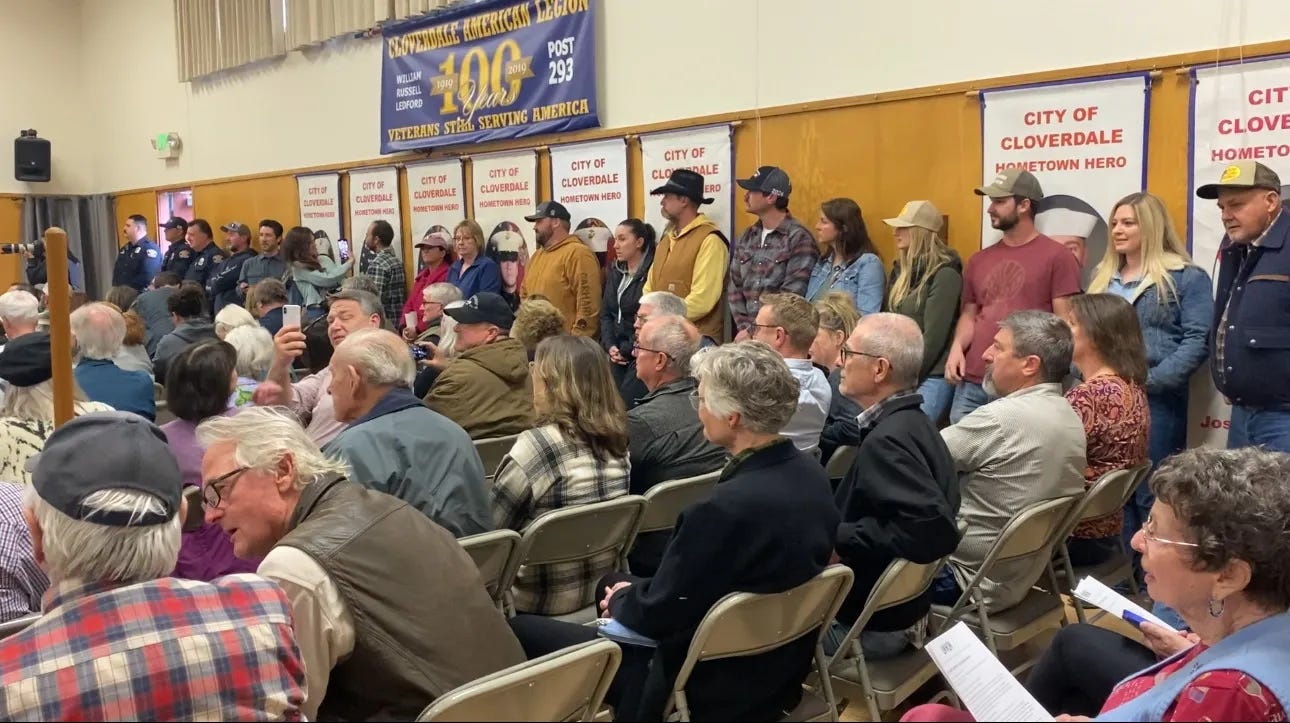
On March 20, 2025, it was standing room only at the Cloverdale Town Hall. People lined the walls and spilled into the entryway of the Veteran’s Hall to hear from a panel on the Potter Valley Project dam removals. Organized by local leaders like Todd Lands and Chris Coulombe, it was one of the first attempts to rally Lake, Mendocino, and Sonoma counties, whose survival lay in the balance.
“This plan is unacceptable as a fire chief,” said Cloverdale Fire Chief Jason Jenkins. “This is not a plan that protects our community.”
“We are not looking for support to keep Lake Pillsbury, we can fight our own fights,” said Lake County Supervisor Bruno Sabatier. “What we want is support to have our voices heard, which has been completely declined.”
Then community members spoke. No one supported dam removal. Many were relieved to learn they were not alone, that they could stand with their neighbors against what had seemed like their inevitable demise, that they could fight.
“None of the people who are trying to take the dams out are from here—none of them,” said Clifford Berry, who moved home from Yreka after the Klamath removal. “The dams are a gift from our ancestors.”
Berry talked about what he had witnessed in the Klamath. He described it as “one of the largest man-made disasters in our nation’s history.”
“They’re trying to repeat it. Not only did they destroy the river, they destroyed the bay, and they killed an entire ecosystem. It’s dead, it will never be the same.”
That night in Cloverdale was a turning point.
Summer 2025 previews a future without water
A few months later, PG&E cut the water to Potter Valley residents with no notice.
“We’re looking at having to go out of business,” said cattle rancher Bernie Eckels.
“This shuts us down,” said his wife Kay. “It affects everything. It affects our well, it affects the grass for the cows.”
“This happened two months before harvest,” says Ken Foster, a Potter Valley farmer. “Everyone is scrambling.”
I had been sharing videos and reporting on the dam removal. That August I began posting videos of locals like Bernie and Kay and Ken—farmers, ranchers, firefighters, families—describing the water cuts. They were viewed millions of times.
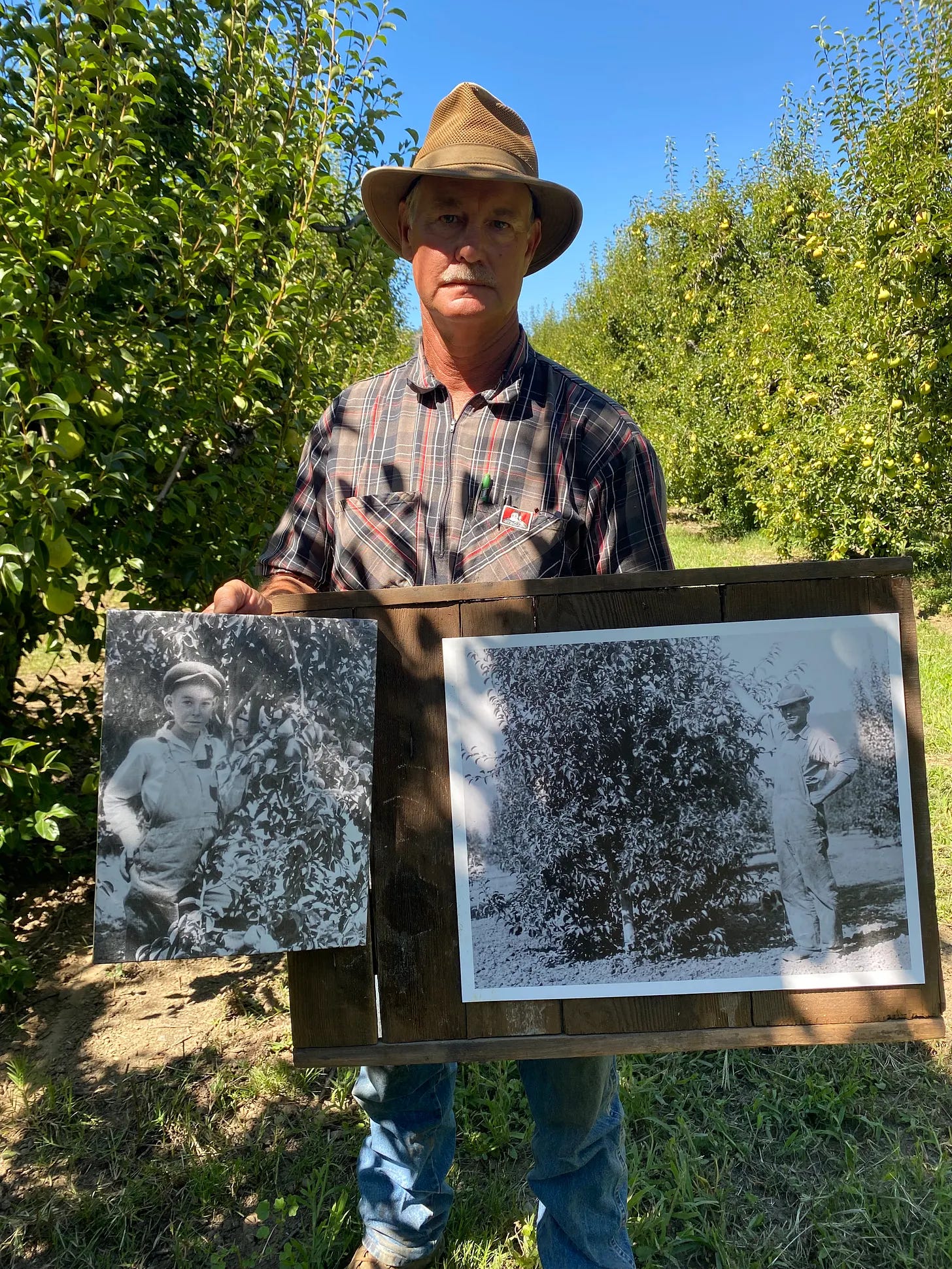
My reporting on lawfare and abuse of farmers and ranchers had begun getting attention. Wherever and whenever I could, I talked about Potter Valley.
In September, more than 900 farmers, ranchers, tribal leaders, and residents signed an open letter to the Trump administration asking for federal intervention.
Secretary Brooke Rollins at the U.S. Department of Agriculture has become the leading federal champion of our cause. The USDA filed motions to intervene in FERC’s process, along with formal comments opposing dam removal.
The Department of the Interior under Secretary Doug Burgum and Associate Deputy Secretary Karen Budd Falen also moved to intervene in November 2025, citing the Endangered Species Act, the Federal Land Policy and Management Act, the Reclamation Act, and federal trust responsibility to tribal lands.
In December 2025, PG&E abruptly withdrew its request to make the Potter Valley water cuts permanent.
Making Potter Valley famous
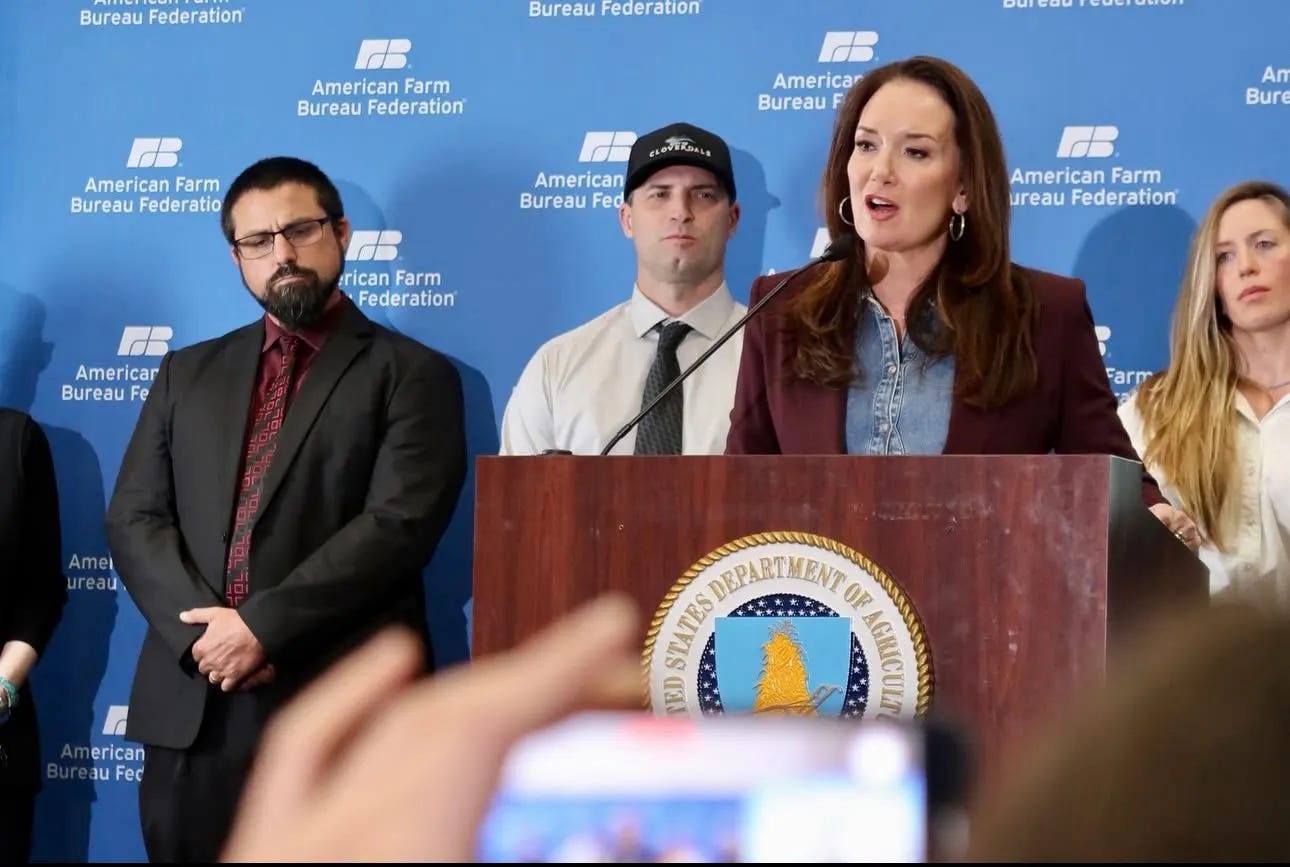
Two weeks after my son was born, in January 2026, I met Secretary Rollins and Natural Resources Conservation Service Chief Aubrey Bettencourt at the American Farm Bureau Convention in Anaheim, California with a group of stakeholders—Lake County supervisors, local advocates, farmers and ranchers, who drove 10 hours or flew on short notice to meet with them. We were given a few weeks’ notice and asked to gather a group of 10 or so. We could have easily filled the room.
After our roundtable, Secretary Rollins handed over her press conference to our group. She had me speak at the USDA podium to gathered California media, there to listen to her, in order to bring attention to the story.
In February, my dad Dr. Rich Brazil and sister Grace traveled to D.C. to take part in a roundtable on agricultural lawfare hosted by Secretary Rollins.
There, Secretary Rollins rolled out the Farmer and Rancher Freedom Framework, formalizing her efforts to stop government overreach and abuse against producers. My dad represented rural water users who rely on the Potter Valley Project.
“This is an issue about weaponization of government against its people,” he said. Then he addressed California officials: “Leave us alone. Why are you taking our water? Why are you destroying our homes and our farms and our ranches? We pay our taxes. We just want to work, we want to be left alone. We're trying to feed America.”
Shortly after, buyers came forward, interested in purchasing the dam.
Did PG&E really try to sell the dams?
For years, we had been told that no one wanted the Potter Valley Project. We had been told that the water infrastructure that built our beloved community was worthless.
“PG&E offered all of this up for sale several years ago. Nobody wanted it. Nobody was dumb enough to buy a project that they could lose $6 million a year,” Huffman told a Ukiah town hall in April 2025. “They tried to give this thing away.”
But now that word was getting out, that narrative seemed questionable.
“I keep looking for the email or the flyer that went out to all the water companies and the water agencies and distributors that said, hey, anybody want to buy this dam?” said Todd Lands, vice mayor of Cloverdale, on the Like It Or Not Podcast. “It doesn’t exist. It didn’t happen.”
To date, four groups have come forward with serious intentions.
The first to go public was the Elsinore Valley Municipal Water District (EVMWD), which says it wants to buy the project, keep both dams, restart hydroelectric generation, and preserve the water supply.
Congressman Huffman responded by opening an “investigation,” sending demand letters to Rollins, Interior Secretary Doug Burgum, and the prospective buyer, and calling it a Southern California “water grab.”
The district’s vice president Darcy Burke told me: “I have no intention of stealing your water. No intention of changing how Potter Valley lives. What we want to make sure is that it’s protected.”
Potter Valley fights back
The pressure did not only come from Huffman. In late April 2026, City of Ukiah attorney Phil Williams drafted a public records demand letter seeking all communications between EVMWD and local advocates: my father, Rich Brazil; Cloverdale vice mayor Todd Lands; Shelina Moreda, then a candidate for Sonoma County supervisor; and me. Williams circulated it to local agencies for signature. Several refused, including the Potter Valley Irrigation District (PVID), the oldest irrigation district in California.
On 24 hours’ notice, about 100 people packed a special PVID meeting to oppose the letter, the largest turnout in the district’s history.
“I found it very offensive that they went after Rich Brazil and Keely,” said Dan Thornton, a PVID board member and fifth-generation pear farmer. Vice president Guinness McFadden called the letter “hostile,” saying it “discourages legitimate potential buyers,” and described pushback from people “invested politically, in that they want this dam down.
Williams, who attended, admitted he had “failed catastrophically to build a coalition.” He urged the crowd to think carefully, warning the implications could be “long-lasting.” Williams repeated three times that his comments were “not a threat.”
PVID chair Janet Pauli said the letter was being set aside for now, but could be taken up again if information is not “forthcoming.”


Department of Interior questions NERF viability
On September 18, 2026, the Department of the Interior officially joined the Department of Agriculture in opposing PG&E’s dam removal plans. In a nine-page filing, Interior asked federal regulators to stop PG&E from tearing out Scott Dam and Cape Horn Dam—at least until a replacement water supply is up and running. The department also expressed skepticism with NERF, claiming it “is not in place, is not funded for construction, is not sized or timed to meet irrigation-season demand, and has no demonstrated place to store the winter water it would divert.”
"It should not issue a surrender order that allows Scott Dam and Cape Horn Dam to come down on a promise," the department wrote.
Uncertain future for the Redwood Empire
This is where things are today.
I’ve heard more than once that what has happened in Potter Valley is a “movie script.” We are the ultimate David and Goliath story, a clear tale of right and wrong, good and evil. But Hollywood likes a happy ending, and ours is uncertain. We have federal support, but the state is against us. Unless a miracle happens, these dams will come down, and the region will be changed forever. Whatever backroom our fate was decided in, we were not invited.
When the water is gone, the farms and ranches are shut down, the wells are dry, and still the fish don’t come, they will never admit what they did. The powers that be wanted this done for their talking points, and whatever political capital they were willing to trade us for will be spent before they ever have to answer for the communities they killed in its pursuit.
There’s a chance we beat them, against all money and odds. If we don’t, this inconvenient record will stand.
Potter Valley Project Decommissioning Timeline
1930: PG&E acquires the Potter Valley Project
2002: National Marine Fisheries Service issues Biological Opinion
2004: Diversions from the Eel River cut by more than half, from 150,000 to 60,000 acre feet
2014–2017: PG&E responsible for more than 1,500 fires, per the Wall Street Journal
2016: Governor Jerry Brown vetoes multiple fire prevention bills
April 6, 2017: PG&E files Notice of Intent with FERC to relicense Potter Valley Project
2017: PG&E evaluates all 67 of its hydroelectric powerhouses for possible divestiture
October 2017: PG&E equipment sparks the Redwood Complex Fire in Potter Valley
January 26, 2018: PG&E tells the California Energy Commission it is “continuing to evaluate its options for the Potter Valley Project”
2018: Congressman Huffman forms the Potter Valley Project Ad Hoc Committee to pursue a “Two Basin Solution”
July 2018: Mendocino Complex Fire, third-largest in state history, fought with water from Lake Pillsbury
September 6, 2018: PG&E opens public auction to sell the Potter Valley Project
November 6, 2018: Gavin Newsom elected governor
November 8, 2018: PG&E equipment sparks the Camp Fire; 85 killed
January 7, 2019: Newsom inaugurated
January 9, 2019: Newsom tells the San Francisco Chronicle he has the cell phone numbers of PG&E executives and can have “very honest conversations”
January 14, 2019: PG&E announces it will file for bankruptcy
January 25, 2019: PG&E withdraws from relicensing the Potter Valley Project and ends the auction the same day
January 29, 2019: PG&E files Chapter 11 bankruptcy
February 2019: Newsom’s office signs $9.6 million contract with O’Melveny & Myers, PG&E’s former law firm, to draft the bailout bill
June 18, 2019: Six PG&E representatives meet with Newsom staff, O’Melveny’s lead attorney, and Newsom energy advisor Alice Reynolds
July 12, 2019: Newsom signs AB 1054, creating a $21 billion Wildfire Fund, half paid by ratepayers
June 2020: PG&E pleads guilty to 84 counts of manslaughter
August 2020: August Complex Fire, largest in state history, fought with water from Lake Pillsbury
June 2021: PG&E pulls the powerhouse transformers; plant goes offline
July 2021: PG&E equipment sparks the Dixie Fire, second-largest in state history; eligible for the AB 1054 fund
November 22, 2021: Newsom appoints Alice Reynolds president of the California Public Utilities Commission, effective December 31
2022: Huffman writes to FERC calling dam removal “a compelling opportunity for environmental justice and restoration”
July 8, 2022: PG&E files surrender plan for Potter Valley Project; FERC approves July 29
2023: PG&E lowers Scott Dam’s radial gates, cutting Lake Pillsbury’s capacity by about 20,000 acre feet
November 17, 2023: PG&E releases draft decommissioning plan proposing removal of Scott Dam
2023–2024: Klamath River dams removed
January 30, 2024: Newsom pledges to the AP to “complete an agreement by the end of the year to remove the Scott Dam”
2024: Regulators approve six PG&E rate hikes; PG&E posts $2.47 billion profit
February 2025: CalTrout, Trout Unlimited, Round Valley Indian Tribes, CDFW, and Sonoma Water sign dam removal MOU; CDFW commits $18 million
April 2025: Huffman tells Ukiah town hall “nobody wanted” the project
July 25, 2025: PG&E files final surrender application and decommissioning plan
August 4, 2025: FERC approves PG&E’s water cuts to Potter Valley, six days after questioning them
October 31, 2025: FERC accepts surrender application, opens comment period
November 2025: Department of the Interior intervenes; USDA follows
November 22, 2025: Round Valley attorney tells tribal members “the diversions will stop”
December 2025: PG&E withdraws request to make water cuts permanent
September 18, 2026: Department of the Interior asks FERC not to allow dam removal before a replacement water supply is running; requests a full environmental impact statement